AI Agents in 2026 Move From Chatbots to Software Infrastructure
AI KAPTAN
August 16, 2026
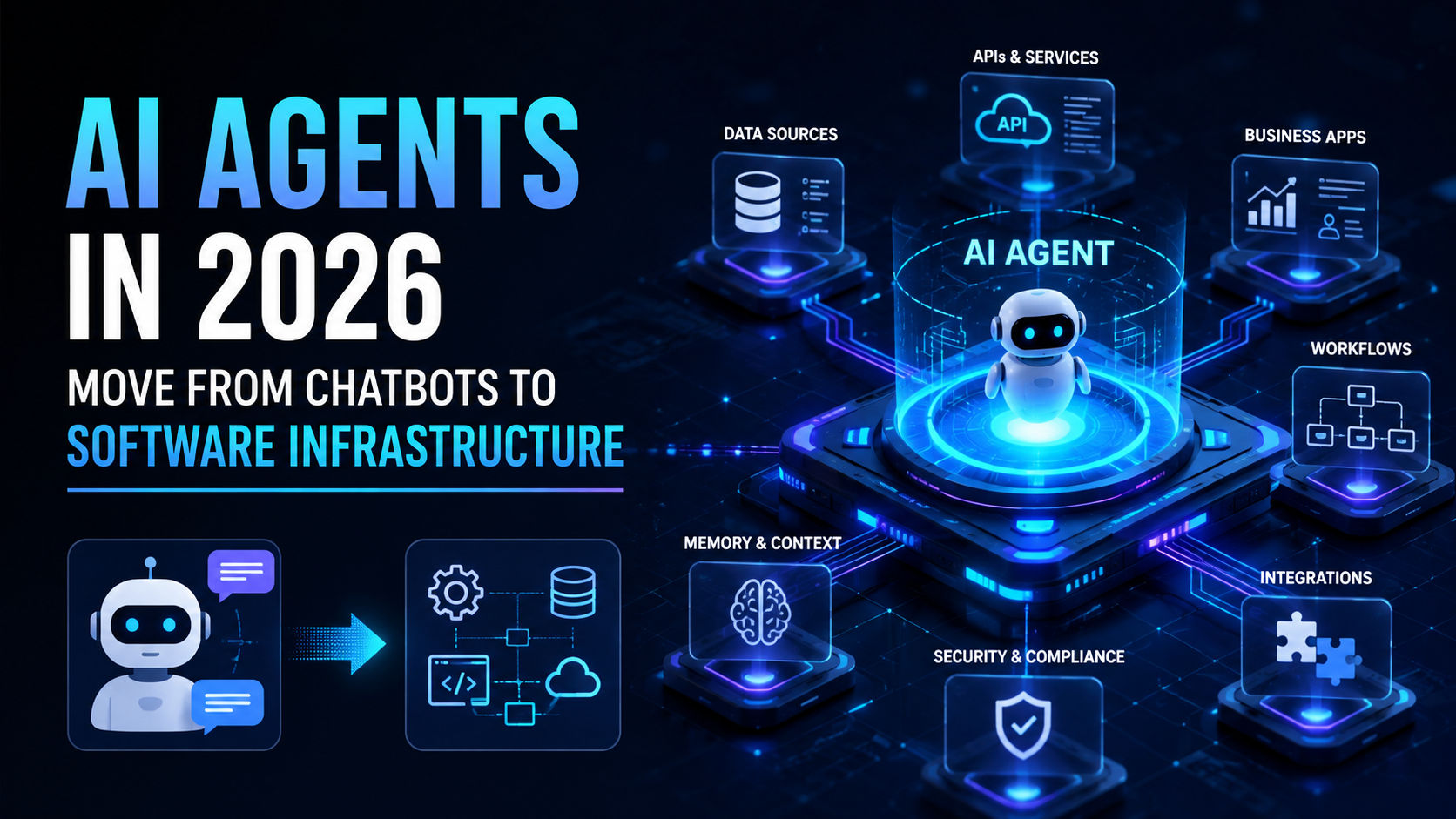
Quick answer: AI agents 2026 are increasingly being treated as software systems that can plan, use tools, access information and take actions across connected services. Cloudflare's August 2026 Agents Week and Oracle's August 11, 2026 announcement show how companies are building infrastructure and business applications around this model.
Key Facts
- Cloudflare published “Everything we launched during Agents Week” in August 2026 and described agents as a new class of software affecting how people interact with technology and how software interacts with the Internet.
- Cloudflare said its agent-focused work addresses identity, communication, orchestration, memory, observability and security as agents become more capable and autonomous.
- Cloudflare introduced
@cloudflare/computer, described as a new runtime designed for agents that need a computer rather than a container. - Oracle announced new Fusion agentic applications and AI agents for talent management on August 11, 2026.
- Agentic.ai's 2026 review describes general-purpose agents as systems that can handle conversations, research, code, data analysis, image generation, file processing and increasingly autonomous multi-step work.
AI Agents 2026: The Shift From Answers to Actions
The defining idea behind AI agents 2026 is execution. A conventional AI interaction usually ends when a model produces an answer. Agentic systems are being designed to continue through a sequence of steps: understand a goal, plan work, use tools, access information, act and evaluate results.
A June 2026 article from ritnav.online describes this model as a move from AI that assists with individual actions toward an active software layer capable of executing workflows. The article points to agentic capabilities across Google Search and Gemini and describes OpenAI's approach as involving longer-horizon tasks, tool calls and iterative execution.
That distinction also appears in agent evaluations. Agentic.ai's 2026 guide says general-purpose agents increasingly combine research, coding, data analysis, image generation and file processing with autonomous multi-step work. Agentic.ai evaluates these systems using a 36-point framework covering capability, autonomy, planning, reliability, safety and other dimensions.
Cloudflare Puts Infrastructure at the Center
Cloudflare's August 2026 Agents Week provides one of the clearest signals in the brief that agent development is becoming an infrastructure problem as much as a model problem.
According to Cloudflare, increasingly autonomous agents create requirements around identity, communication, orchestration, memory, observability and security. Those components sit underneath an agent's visible interaction with a user, but they determine how an agent can operate across systems and the Internet.
Cloudflare also introduced @cloudflare/computer, which Cloudflare described as a runtime designed for agents. The announcement frames the runtime around a specific requirement: an agent may need access to a computer environment rather than simply running inside a conventional container.
This changes the engineering question. Developers building AI agents need to consider where an agent operates, how it communicates with other systems, how it retains information, and how its actions can be observed and secured.
Cloudflare's Agents Week recap describes this broader direction as an “Agentic Internet,” where humans and agents cooperate across software and online services.
Business Software Is Becoming Agentic
The move toward AI agents is also appearing inside enterprise applications. Oracle announced new Fusion agentic applications and AI agents for talent management on August 11, 2026.
The Oracle announcement matters because it places agents inside an established business-software category rather than treating agents only as standalone assistants. The brief does not provide enough detail to assess the specific capabilities of Oracle's new agents, so the announcement is best read as evidence of where enterprise software development is heading rather than as proof of any particular productivity result.
Customer service provides another example of how the category is being defined. A 2026 LinkedIn article on customer-service agents describes systems that can reason through multi-step problems, retrieve information from multiple systems and take actions such as issuing refunds, updating records and rebooking flights.
That article draws a clear distinction between scripted chatbots and goal-oriented agents. The difference is the ability to carry out work rather than simply return a response.
Coding Agents Show the Same Pattern
The same transition is visible in software development. A 2026 Medium article titled “10 AI Coding Agents Developers Should Know in 2026” reflects the growing focus on coding agents as a distinct category of developer tooling.
The research brief does not provide enough detail from that article to identify or compare the ten agents, so this article does not assign rankings or make unsupported claims about individual coding products.
What the broader brief does establish is that agentic systems are spreading across different forms of work: coding, customer service, research, data analysis and enterprise applications. The common thread is the move toward systems that can execute multiple steps toward a defined goal.
What Developers Need to Consider
For developers, the infrastructure requirements may become as important as model selection. Cloudflare's Agents Week recap explicitly identifies identity, communication, orchestration, memory, observability and security as areas that need to be addressed as agent autonomy increases.
That list also gives a practical way to evaluate an agent architecture. A useful question is not simply which model produces the best answer. Developers can also ask what tools the agent can access, where it can operate, how its actions are tracked, what information it can retain and what security controls surround those actions.
The business examples in the research brief point in the same direction. Oracle is applying agents to talent management, while customer-service systems are being described as capable of completing multi-step operational tasks. AI agents are increasingly being positioned as participants in workflows rather than isolated chat interfaces.
Where AI Agents 2026 Are Heading
The research brief points to a consistent development pattern without requiring speculation about future products. General-purpose agents are expanding across task types, coding agents are becoming a defined software category, enterprise applications are adding agents, and infrastructure providers are building runtimes and supporting systems for autonomous software.
Cloudflare's Agents Week is especially useful for understanding the technical side of that shift. The company is treating the agent as a software actor that needs identity, communication, memory, observability and security. Oracle's August 11 announcement shows the same category entering enterprise applications.
The result is a broader definition of AI software: systems are increasingly being designed to carry a goal through multiple steps instead of stopping after generating an answer.
FAQ
What are AI agents in 2026?
AI agents are AI-powered software systems designed to pursue goals through multiple steps, including planning, tool use, information access, actions and evaluation.
How are AI agents different from chatbots?
Chatbots generally respond to user prompts, while AI agents can be designed to plan and execute multi-step tasks using connected tools and systems.
What did Cloudflare announce during Agents Week in August 2026?
Cloudflare announced agent-focused infrastructure and described work covering identity, communication, orchestration, memory, observability and security. Cloudflare also introduced @cloudflare/computer, a runtime designed for agents.
What did Oracle announce on August 11, 2026?
Oracle announced new Fusion agentic applications and AI agents aimed at talent management.
Where are AI agents being used in 2026?
The research brief identifies applications across coding, customer service, research, data analysis, image generation, file processing and enterprise software such as talent management.
Author