
AI Marketing Tools in 2026: A Practical Use-Case Guide
AI KAPTAN
August 14, 2026
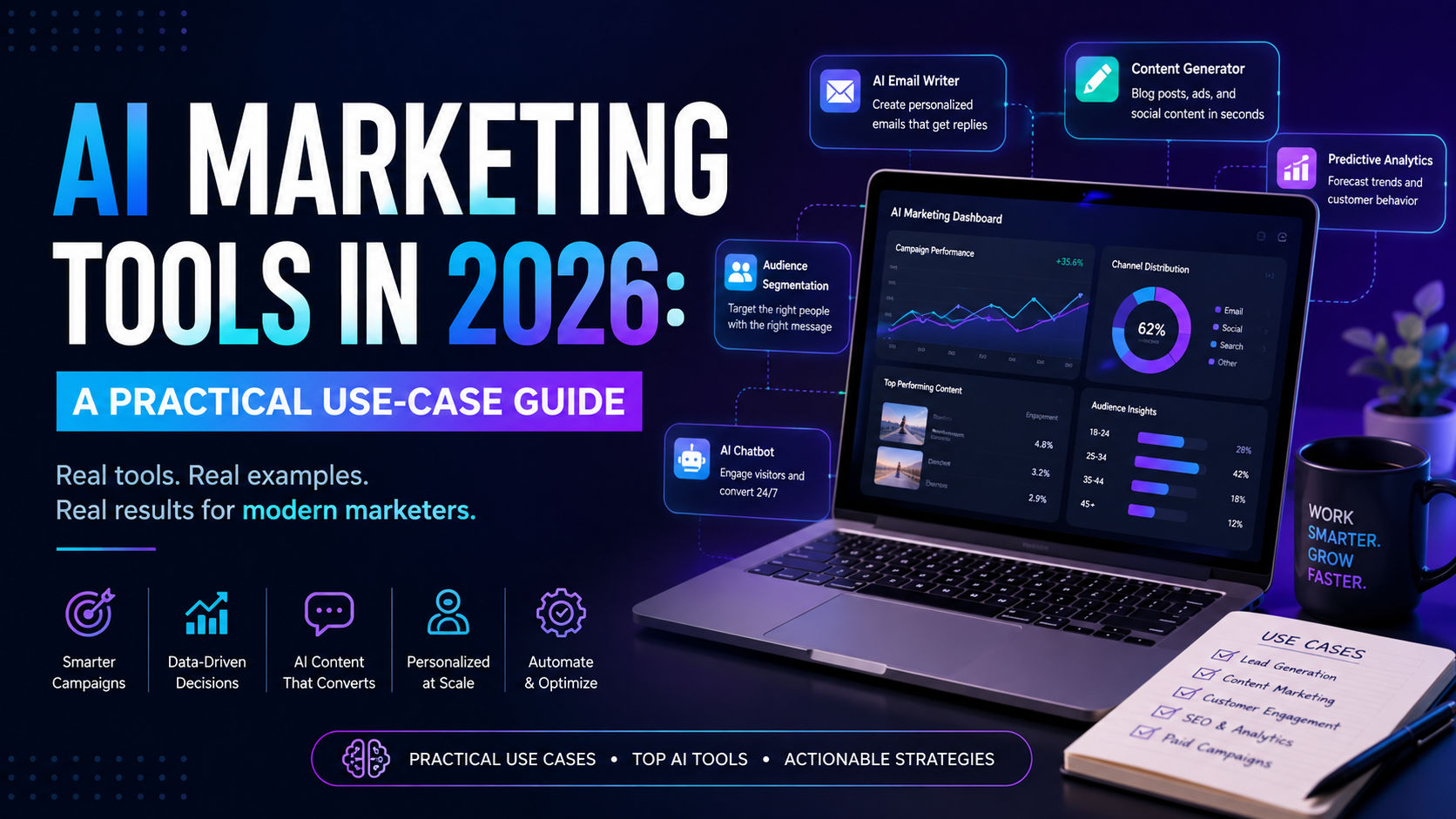
Quick answer: The best AI marketing tools in 2026 depend on the marketing job you need to remove, rather than a single universal ranking. The research brief points to a use-case approach spanning creative production, business software, workflow automation, productivity, and mobile lifecycle marketing.
Key Facts
- OneSignal's 2026 guide recommends mapping AI marketing tools to specific mobile marketing jobs instead of ranking every tool against the others.
- OneSignal identifies Canva Magic Studio for first drafts of push notification images, in-app message visuals, App Store screenshots, and feature-announcement social posts.
- Storyflow's 2026 productivity-tools ranking places ChatGPT first, Claude second, and Granola as a clear example of an AI-native product.
- Mastra's 2026 business AI guide groups tools by jobs such as chatbots, analytics, and agent frameworks and discusses when building an agent can make more sense than buying one.
- A LinkedIn post from Austin Armstrong lists ChatGPT, Ranked.ai, Syllaby.io, Whisperjot.com, and Littlebird.ai as five AI tools worth using in 2026.
- A YouTube video from Alex Finn titled "Every AI tool you need to be using in August 2026" was published three days before the research brief was compiled.
Why AI Marketing Tools Are Moving Toward Use Cases
The research brief points to a problem with the traditional "best AI tools" format: different teams need different systems, and many tools solve different parts of the same workflow.
OneSignal's 2026 guide makes that case specifically for mobile marketers. Instead of presenting a winner-takes-all ranking, OneSignal organizes tools around the jobs AI can handle for mobile growth teams. The guide argues that multiple tools can coexist because creative production, acquisition, lifecycle messaging, and other marketing activities require different capabilities.
That approach is more useful for teams choosing software. A marketer creating App Store assets has a different requirement from someone analyzing business data or building an automated workflow. A single leaderboard can hide that distinction.
AI Marketing Tools for Creative Production
For marketers who need a steady flow of campaign assets, Canva Magic Studio is one of the clearest examples in the brief.
According to OneSignal, Canva Magic Studio can help lifecycle marketers create first drafts of push notification images, in-app message visuals, App Store screenshots, and feature-announcement social posts. Its listed AI capabilities include text-to-image, text-to-video, and AI copywriting for headlines and captions.
The important use case is volume. Mobile lifecycle programs can require many smaller creative assets every week. OneSignal positions Canva Magic Studio around that recurring production workload rather than presenting it as a universal marketing platform.
AI Marketing Tools for General Knowledge Work
The research brief also shows how quickly the definition of an AI tool has expanded beyond marketing software.
Storyflow's 2026 ranking of 11 AI-native productivity tools evaluates products using three tests designed to distinguish AI-native software from conventional software with a chatbot attached. Storyflow ranks ChatGPT first and Claude second, while describing Granola as a strong example of a product where AI is central to the experience.
The distinction matters for marketers because general-purpose AI can sit across many tasks. Writing, research, planning, analysis, and other knowledge-work activities can happen in the same environment rather than requiring a separate specialized marketing application for every task.
Storyflow also discloses that Storyflow itself appears at number five in the ranking and is a paid-only product during early access. That disclosure gives useful context for interpreting the ranking rather than treating the list as an independent market-wide scorecard.
AI Marketing Tools for Business Operations
Mastra takes a broader business view. Its 2026 guide groups AI tools into categories including chatbots, analytics, and agent frameworks, while focusing on the specific capability that matters in each category and the trade-offs involved.
The guide also addresses a practical decision: when should a business buy an existing agent, and when should the business build its own?
That question is increasingly relevant to marketing operations. Marketing teams often work with customer records, campaign data, content, and repetitive processes. The value of an AI system depends partly on whether the system can act on that information rather than simply store or display it.
Mastra's guide describes business AI tools as a layer that can read records, generate text and media, predict outcomes, and trigger actions. Those capabilities point toward AI being embedded in workflows rather than isolated inside a chat window.
AI Workflow Automation Tools
Workflow automation is another distinct category in the research brief. Composio's 2026 article specifically covers AI workflow automation tools, while Sybill's 2026 guide compares 15 AI platforms by use case.
For buyers, the practical lesson is the same one found in OneSignal's mobile marketing analysis: start with the work that needs to be done. A workflow automation tool should be evaluated differently from a creative generation platform, an AI-native productivity application, or an analytics product.
This use-case framing also reduces the temptation to replace an entire software stack simply because a competitor has added an AI feature. Mastra's guide notes that many vendors have added AI features to existing products, but the quality of those features varies. The relevant question is whether the feature removes meaningful work.
A Smaller AI Stack Can Still Cover Many Jobs
A LinkedIn post from Austin Armstrong offers a much shorter list: ChatGPT, Ranked.ai, Syllaby.io, Whisperjot.com, and Littlebird.ai.
The five tools represent different workflows. ChatGPT is described for coding, research, and writing. Ranked.ai is positioned around AI SEO. Syllaby.io focuses on AI-generated videos and social publishing. Whisperjot.com turns voice into text on a Mac, while Littlebird.ai creates an AI agent based on computer usage.
The list illustrates why a single "best AI tool" answer is difficult. Each product is aimed at a different job, and the usefulness of each depends on the user's workflow.
The same pattern appears across the research brief: Canva Magic Studio for recurring creative production, ChatGPT and Claude for general knowledge work, business AI platforms for operational tasks, and workflow automation products for connected processes.
How to Choose AI Tools in 2026
The strongest approach supported by the research brief is to begin with a task rather than a vendor.
First, identify repetitive work that consumes time. Then determine whether the required capability is content generation, creative production, research, analysis, automation, or another specific job. After that, compare tools within that category instead of comparing unrelated products on a single leaderboard.
For marketing teams, this can produce a smaller and more understandable stack. A team may use one tool for creative drafts, another for general AI work, and another for workflow automation. OneSignal explicitly argues that mobile marketing teams will often use more than one AI tool because the tools serve different jobs.
The research brief also suggests evaluating whether AI is actually central to the product. Storyflow's three-test approach asks whether removing AI would materially change how the software is used. That is a useful filter when many existing products now advertise AI features.
The result is a more practical buying question: Which AI tool removes a specific piece of work your team actually does?
FAQ
What are the best AI marketing tools in 2026?
The best AI marketing tools depend on the job. The research brief highlights Canva Magic Studio for creative production and points to broader AI, business, and workflow tools for other marketing tasks.
Is there one AI tool that can handle every marketing task?
The research brief does not support a single universal winner. OneSignal argues that mobile marketing teams will often use multiple tools because different products handle different jobs.
What is Canva Magic Studio useful for in marketing?
According to OneSignal, Canva Magic Studio can help create first drafts of push notification images, in-app message visuals, App Store screenshots, and feature-announcement social posts.
Which AI productivity tools rank highly in 2026?
Storyflow's 2026 ranking places ChatGPT first and Claude second among the 11 AI-native productivity tools it evaluates. Granola is highlighted as a clear example of AI-native software.
How should businesses evaluate AI tools?
Mastra recommends comparing tools by category, capability, and trade-offs. The research brief supports starting with the business job that needs to be done and then choosing the tool that addresses that job.
What is the main trend across AI tools in 2026?
The research brief points toward use-case-based selection. Tools increasingly cover specific jobs such as creative production, knowledge work, analytics, agent development, and workflow automation rather than fitting neatly into one universal category.
Author