AI Tools 2026: Offline Models, Watermarking and Speed
AI KAPTAN
August 17, 2026
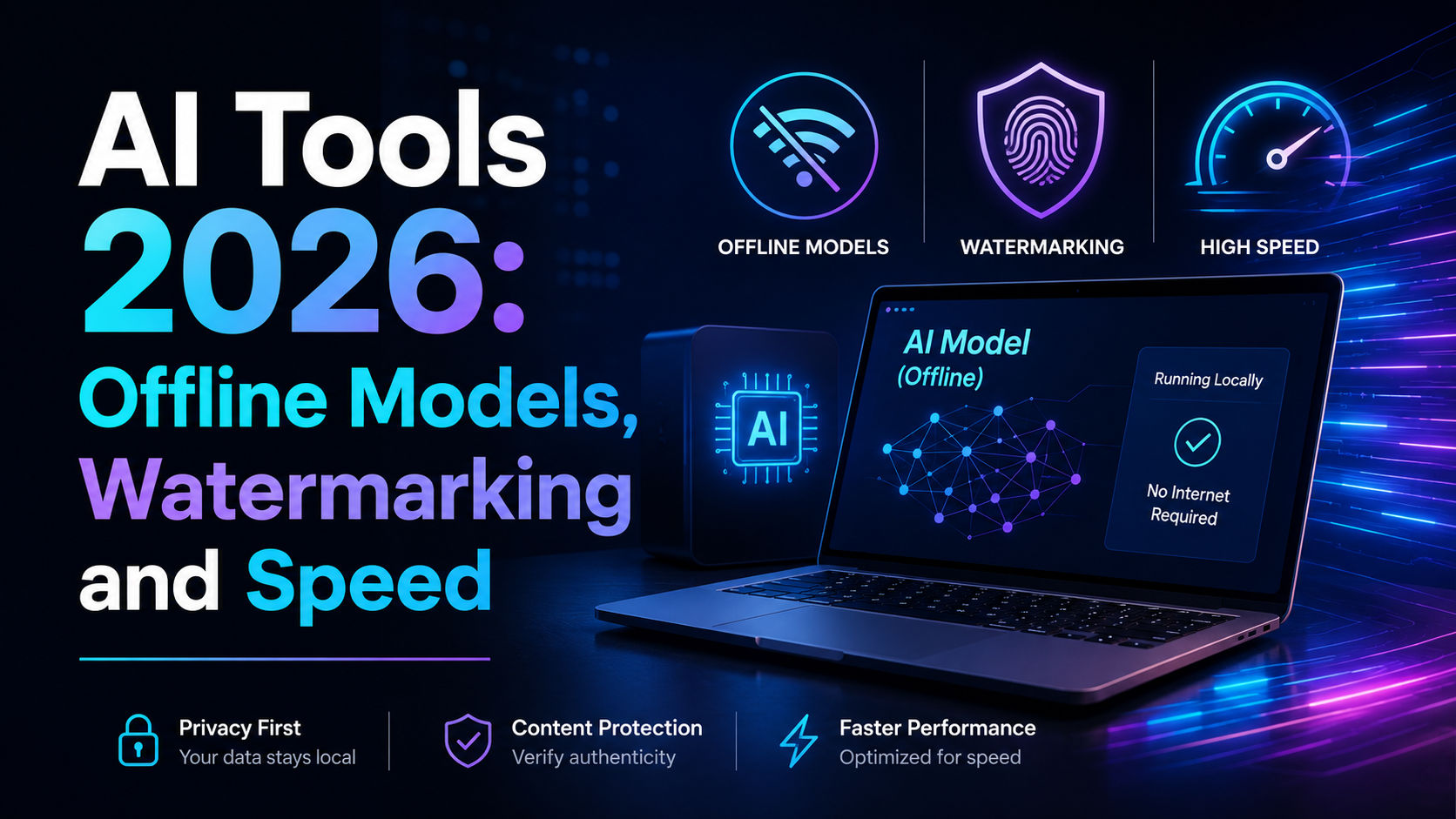
Quick answer: AI tools 2026 are moving in several directions at once: Meta is introducing an open-source offline model, Anthropic is working on watermarking for Claude-generated text, and OpenAI has announced a major speed improvement for a flagship model. Together, these updates point to practical changes in where AI runs, how generated content can be identified, and how quickly users receive results.
Key Facts
- Anthropic has introduced internal watermarking technology for text generated by Claude AI models, according to aixplore.in in its latest AI updates coverage.
- Meta has introduced Muse Glimmer, described by aixplore.in as a lightweight, open-source agentic AI model designed to operate entirely offline.
- According to aixplore.in, OpenAI announced a performance improvement making its flagship AI model 14 times faster than previous versions while retaining its intelligence and reasoning capabilities.
- Pluralsight's 2026 coverage examines how software engineers use AI tools across the software development lifecycle rather than treating AI adoption as a single general workplace skill.
- Mastra's 2026 business AI tools guide groups products by use case and notes that businesses increasingly need to distinguish useful AI features from demonstrations that do not translate into practical products.
- LinkedIn's August 9-14, 2026 edition of The AI Signal highlighted major AI developments involving security, infrastructure investment and company valuations.
AI Tools 2026: Three Updates Worth Watching
The strongest AI updates in the research brief are not variations of the same product announcement. They address three different parts of the AI experience: local execution, content provenance and model performance.
That makes this week's developments more useful to examine as a group than as a single product story. The updates also fit the broader focus seen in 2026 coverage from Pluralsight and Mastra, where the question is increasingly how AI tools fit specific jobs and workflows.
Meta's Muse Glimmer puts offline AI in focus
According to aixplore.in, Meta has introduced Muse Glimmer, an open-source AI model designed to operate entirely offline. The publication describes Muse Glimmer as a lightweight agentic model capable of handling complex tasks locally on a user's device.
The offline design matters because local execution changes the requirements around connectivity. An AI system that can operate without a constant internet connection can be positioned for situations where sending every task to a remote service is undesirable or impractical.
The open-source element also matters for developers. According to aixplore.in, Meta's stated direction is to make privacy-focused, efficient, on-device AI applications more accessible to developers.
The research brief does not provide benchmark figures or hardware requirements for Muse Glimmer, so claims about exactly how capable or efficient the model is should be left open. The concrete takeaway is narrower: Meta has introduced an open-source agentic model intended to run locally and offline.
Anthropic's watermarking targets AI-generated text identification
Anthropic has introduced internal watermarking technology for text generated by its Claude AI models, according to aixplore.in.
The technology uses digital signatures embedded directly into generated output. The stated purpose is to make AI-authored text easier to identify and provide a framework for future detection tools that can verify the origin of digital text.
This is a different kind of AI infrastructure from a faster model or an offline agent. Instead of changing how users generate content, watermarking addresses what happens after content has been generated: whether there is a way to establish that the text originated from an AI system.
The research brief does not provide technical details about the watermarking method, detection accuracy, or deployment scope. Those details should not be inferred from the announcement. What can be stated from the available reporting is that Anthropic is working on embedded signatures for Claude-generated text and connecting that work to future AI-content detection.
OpenAI focuses on reducing model wait times
According to aixplore.in, OpenAI has announced a major performance improvement for its flagship artificial intelligence model, making the model 14 times faster than previous versions while maintaining its intelligence and reasoning capabilities.
Speed is particularly relevant for AI workflows that involve repeated interaction. A faster response can reduce waiting between prompts, iterations and other model-dependent tasks. The research brief does not provide latency measurements, hardware details or a specific model name, so those details cannot be added here.
The important fact from the supplied reporting is the scale of the claimed improvement: 14 times faster. OpenAI's stated position, as reported by aixplore.in, is that the speed increase does not come at the expense of the model's intelligence and reasoning capabilities.
What These AI Updates Mean for Developers
The three announcements point to different technical priorities.
Muse Glimmer is about where computation happens. An offline, open-source agentic model gives developers a route toward applications that can perform AI tasks locally.
Anthropic's watermarking technology is about identifying where generated text came from. Embedded digital signatures could support future systems for establishing the origin of AI-generated text, although the brief does not establish how broadly such systems will work.
OpenAI's speed improvement is about how quickly a model can respond. The reported 14-times improvement targets the waiting time associated with AI interaction while preserving the model's stated reasoning capabilities.
Pluralsight's 2026 analysis provides useful context for interpreting these changes. The publication argues that software engineers use AI differently from other employees and that AI training for engineering teams needs to account for software development workflows. That makes infrastructure-level changes such as model speed, local execution and developer tooling especially relevant to engineering teams.
Business AI Is Becoming More Use-Case Driven
Mastra's 2026 guide takes a similar practical approach. The guide compares AI tools by category, including chatbots, analytics and agent frameworks, and focuses on strengths and trade-offs rather than treating every AI feature as equally useful.
That approach is relevant to the latest announcements. A faster model may matter most where response time affects a workflow. An offline model may matter when local execution is a requirement. Watermarking may matter when the origin of generated text needs to be established.
The research brief does not support a claim that one of these technologies is universally better than the others. The more defensible conclusion is that AI tools 2026 are becoming differentiated by the specific problem they solve.
For businesses evaluating new AI products, that means the useful question is increasingly concrete: What does the tool change in the workflow, and what capability does the underlying technology provide that existing software does not?
Why the Latest AI Updates Are Worth Tracking
The research brief also includes Google's announcement, "Evolve your marketing with new AI tools," focused on Google Ads analytics and AI updates. Domo's 2026 guide compares AI tools for data analysis, while other sources in the brief cover generative AI and software engineering.
Taken together, these sources show how broad the AI tools category has become. The latest announcements are no longer limited to general-purpose chat interfaces. The supplied research covers offline agents, content provenance, model performance, marketing, analytics, software engineering and business applications.
For today's AI tools 2026 roundup, the clearest developments are the ones with a specific technical direction: Meta's offline Muse Glimmer, Anthropic's watermarking work for Claude, and OpenAI's reported 14-times speed improvement. The available evidence supports those facts without requiring predictions about where the market goes next.
FAQ
What are the biggest AI tool updates in August 2026?
The research brief highlights Meta's Muse Glimmer offline model, Anthropic's watermarking technology for Claude-generated text, and OpenAI's reported 14-times speed improvement for a flagship model.
What is Meta Muse Glimmer?
According to aixplore.in, Muse Glimmer is a lightweight, open-source agentic AI model from Meta designed to operate entirely offline on users' devices.
What is Anthropic doing with AI watermarking?
Anthropic has introduced internal watermarking technology for Claude-generated text. The digital signatures are intended to make AI-authored content easier to identify.
How much faster is OpenAI's updated model?
According to aixplore.in, OpenAI says its flagship AI model is 14 times faster than previous versions while retaining its intelligence and reasoning capabilities.
Why does offline AI matter for developers?
Offline AI allows models to operate locally without a constant internet connection. The research brief says Meta is positioning Muse Glimmer as an open-source option for privacy-focused, on-device AI applications.
How are businesses evaluating AI tools in 2026?
Mastra's 2026 guide recommends comparing AI tools by category, capability, strengths and trade-offs. Pluralsight's 2026 analysis also emphasizes that software engineers have different AI tool requirements from general employees.
Author