
From Training to Inference: Why Markets are Pivoting to Storage and Networking Plays
Ashley Nicole Brown
March 3, 2026
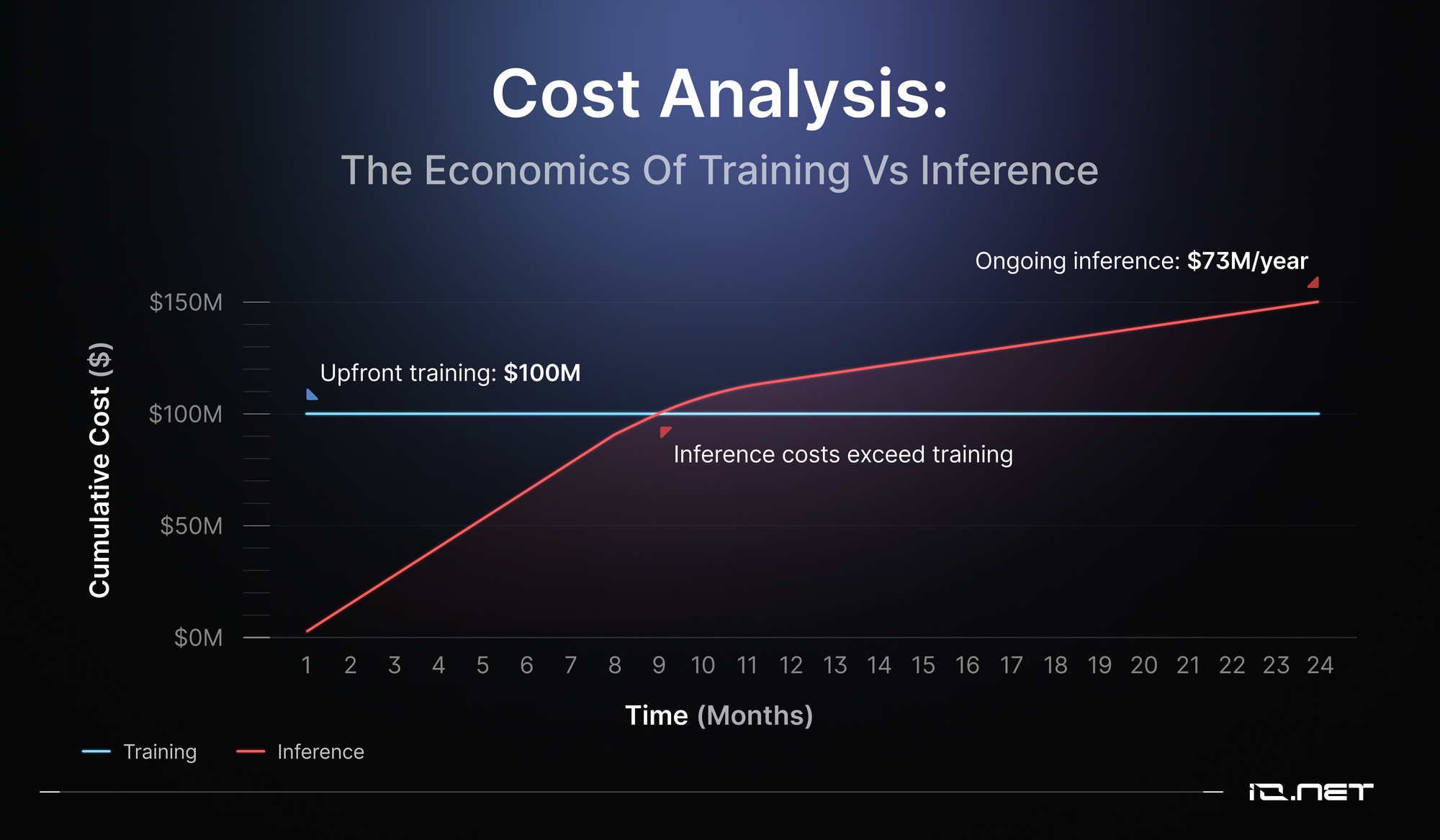
The Great Migration: From Building Brains to Using Them
For the past two years, the artificial intelligence narrative was dominated by the training phase—the massive, capital-intensive process of teaching large language models (LLMs) to understand the world. This era belonged almost exclusively to high-end compute, specifically Nvidia’s H100 and Blackwell GPUs. However, as we move through 2026, the market is witnessing a fundamental pivot toward the inference phase.
Inference is the act of a trained model responding to a live query. While training is a periodic, concentrated burst of activity, inference is continuous, occurring billions of times a day every time a user interacts with a chatbot, a recommendation engine, or an autonomous system. This shift is recalibrating the hardware stack, moving the spotlight from raw floating-point operations (FLOPs) to the pipes and vaults that sustain them: networking and storage.
The Networking Pivot: Ethernet’s Resurgence and the Rise of ASICs
In the training era, InfiniBand was the undisputed king of networking. Its ultra-low latency and lossless fabric were essential for synchronized clusters where thousands of GPUs needed to act as a single machine. But as the industry shifts to inference, the requirements are changing.
1. The Ethernet Offensive
Inference workloads are often distributed across more diverse environments, including edge locations and regional data centers. This has fueled a massive resurgence in Ethernet, led by the Ultra Ethernet Consortium (UEC).
- Cost-Efficiency: Ethernet is significantly cheaper to scale than proprietary InfiniBand fabrics.
- Interoperability: Organizations are favoring Ethernet to avoid vendor lock-in, allowing them to mix and match hardware from Broadcom, Marvell, and Cisco.
- Performance Parity: Innovations like RoCEv2 (RDMA over Converged Ethernet) have narrowed the latency gap. Recent 2026 benchmarks show that for inference tasks, the performance delta between InfiniBand and high-end 800G Ethernet is often less than 1%.
2. The Dominance of Custom Silicon (ASICs)
While Nvidia remains a titan, the inference era is the playground of ASICs (Application-Specific Integrated Circuits). Unlike general-purpose GPUs, ASICs are hardwired for specific tasks, offering superior "performance-per-watt"—a critical metric for inference where operational costs (OpEx) outweigh initial capital expenditure (CapEx). Companies like Broadcom (powering Google’s TPUs) and Marvell are seeing explosive growth as hyperscalers move away from generic chips toward custom-tailored inference engines.
The Storage Revolution: Data is the New Bottleneck
As models grow in complexity and the use of RAG (Retrieval-Augmented Generation) becomes standard, storage has moved from a passive repository to a high-performance active component of the AI stack.
The Shift to All-Flash Architectures
Traditional hard drives (HDDs) simply cannot keep up with the random read requirements of modern inference. The market is pivoting toward All-Flash Arrays (AFA) and high-speed NVMe storage for several reasons:
- Low Latency for RAG: To provide context-aware answers, AI models must query massive vector databases in milliseconds. Any lag in the storage layer results in a sluggish user experience.
- Checkpointing and Throughput: In inference "factories," the ability to swap models in and out of memory rapidly is essential for multi-tenant environments.
- Sustainability: All-flash systems provide more gigabytes-per-watt than spinning disks, helping data centers stay within their increasingly tight power envelopes.
Market Implications: Following the $3 Trillion Investment
Recent data suggests that global data center capacity will need to grow six-fold by 2035. Between 2025 and 2028 alone, an estimated $3 trillion will be invested in infrastructure.
Key Winners in the Shift:
| Sector | Key Players | Growth Driver |
|---|---|---|
| Networking | Broadcom, Marvell, Arista | Transition to 800G/1.6T Ethernet and custom AI switches. |
| Storage | Pure Storage, NetApp, Micron | Demand for high-density QLC flash and HBM (High Bandwidth Memory). |
| Custom Silicon | Broadcom, Marvell | Hyperscalers (Google, Meta, Amazon) building in-house inference chips. |
Conclusion: The Efficiency Era
The pivot to storage and networking plays represents the "industrialization" of AI. We are moving from the experimental phase of "compute at any cost" to a production phase defined by optimization, scalability, and economic viability. In this new era, the value isn't just in the model’s IQ, but in the speed and efficiency with which that intelligence can be delivered to the end user.
Would you like me to analyze the specific fiscal 2026 revenue projections for the top networking and storage vendors mentioned?
Author