Gemini 3.7 Flash Targets Coding and AI Agent Workflows
AI KAPTAN
August 16, 2026
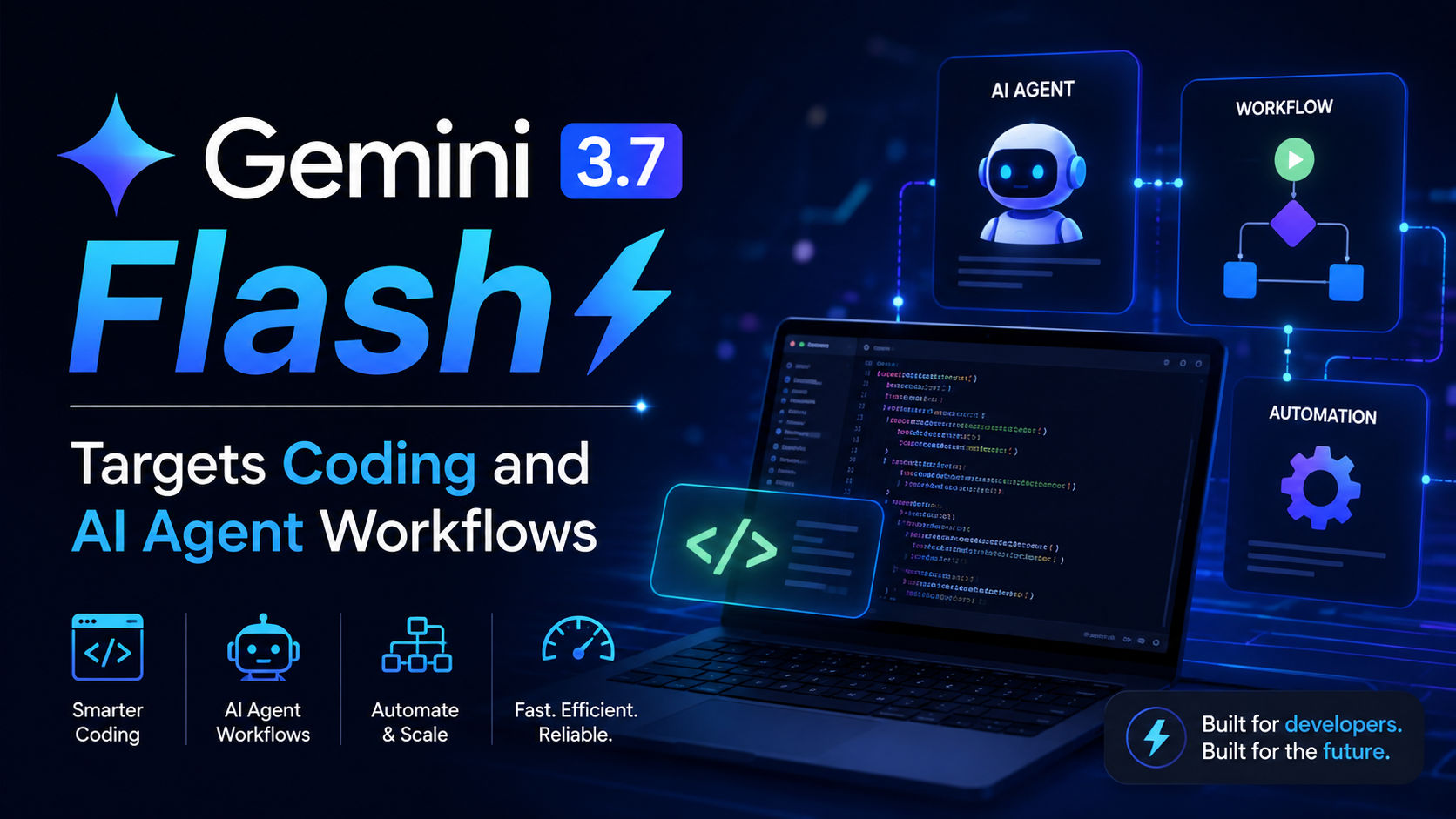
Quick answer: Gemini 3.7 Flash is Google’s latest Flash-series model for coding and agent workflows. According to Google, Gemini 3.7 Flash improves software engineering, knowledge work, web development, and first-pass code accuracy while launching at half the original Gemini 3.6 Flash cost per million tokens.
Key Facts
- Google introduced Gemini 3.7 Flash as its most intelligent workhorse model yet for coding and agents.
- Gemini 3.7 Flash arrived three weeks after Gemini 3.6 Flash, according to Google.
- Google says Gemini 3.7 Flash reaches 43.6% on FrontierCode 1.1 Main, compared with 34.4% for Gemini 3.6 Flash.
- On DeepSWE v1.1, Gemini 3.7 Flash scores 65.3%, compared with 49.0% for Gemini 3.6 Flash.
- Google says Gemini 3.7 Flash launches at half the original Gemini 3.6 Flash cost per million tokens.
Gemini 3.7 Flash focuses on coding and agents
Google is positioning Gemini 3.7 Flash as a workhorse model rather than simply another general-purpose model release. The Google AI team says the model was built around improvements for coding and agents, with gains extending into software engineering, knowledge work, and web development workflows.
The timing is also notable. According to Google, Gemini 3.7 Flash comes just three weeks after Gemini 3.6 Flash. Google attributes the rapid release to developer feedback and algorithmic innovations that are also intended to inform future models.
For developers, the clearest focus is software engineering. Google says Gemini 3.7 Flash performs better than Gemini 3.6 Flash on coding tasks including debugging and issue resolution. The model also delivers higher first-pass code accuracy, an important distinction for workflows where developers want usable code without repeated prompting and correction.
Gemini 3.7 Flash shows higher code accuracy
Google’s reported benchmark results provide a concrete view of the coding improvements. On FrontierCode 1.1 Main, Gemini 3.7 Flash scores 43.6%, compared with 34.4% for Gemini 3.6 Flash. On DeepSWE v1.1, Gemini 3.7 Flash reaches 65.3%, while Gemini 3.6 Flash records 49.0%.
Those results point to a model aimed at practical software-engineering work rather than code generation as an isolated task. Google specifically describes gains in debugging and issue resolution, suggesting that the model is being evaluated for workflows where understanding an existing problem is as important as producing new code.
The results also matter for agent-based development. When an AI system is used as part of a larger coding workflow, repeated errors can create additional review and correction work. Higher first-pass accuracy can reduce some of that friction, although the research brief does not provide a broader measure of how much developer time the model saves.
Gemini 3.7 Flash and web development
Google also reports improvements in web development. According to the Gemini team, Gemini 3.7 Flash generates more functional layouts and feature-complete applications in fewer prompts than Gemini 3.6 Flash.
That makes web development another area where the model’s ability to follow instructions and produce working output is central. Google also says Gemini 3.7 Flash shows high design adherence for UI generation. The research brief does not provide a numerical score for that capability, so the claim is best understood as Google’s description of the model’s observed performance rather than a quantified benchmark result.
For developers building interfaces through natural-language instructions, fewer prompts can matter because each additional iteration adds time and requires the developer to inspect and correct the generated result. Google’s description suggests Gemini 3.7 Flash is designed to handle more of that work within an initial generation cycle.
Gemini 3.7 Flash changes the cost equation
Performance is only one part of Google’s positioning. Gemini 3.7 Flash also launches with an introductory price of half the original Gemini 3.6 Flash cost per million tokens, according to Google.
That pricing detail is particularly relevant to coding and agent workloads, where models can be called repeatedly as part of a development workflow. A lower token cost can make frequent model use more economical, although the research brief does not provide the underlying dollar prices or a projected savings figure.
Google’s combination of higher benchmark scores and lower introductory token pricing gives Gemini 3.7 Flash a clear product proposition: more capable coding and agent performance while reducing the original cost associated with Gemini 3.6 Flash.
What Gemini 3.7 Flash means for developers
The strongest evidence in the brief centers on three areas: coding accuracy, agent-oriented workflows, and web development. Google reports measurable gains on FrontierCode 1.1 Main and DeepSWE v1.1, along with practical improvements in debugging, issue resolution, application generation, and UI generation.
The release also illustrates how quickly Google is iterating on the Flash series. Gemini 3.7 Flash follows Gemini 3.6 Flash by only three weeks, with Google saying developer feedback and algorithmic innovations contributed directly to the new release.
For developers evaluating the model, the most relevant question is not simply whether Gemini 3.7 Flash is newer. The useful comparison is whether its reported improvements in first-pass coding, debugging, web development, and agent workflows translate into better results for the specific tasks a team runs regularly.
Google’s published figures provide a starting point for that evaluation. Gemini 3.7 Flash records 43.6% versus 34.4% for Gemini 3.6 Flash on FrontierCode 1.1 Main, and 65.3% versus 49.0% on DeepSWE v1.1. Combined with the introductory half-price positioning, those are the clearest reasons the new Flash model is aimed at developers looking for a capable workhorse model.
FAQ
What is Gemini 3.7 Flash?
Gemini 3.7 Flash is Google’s latest Flash-series model, designed especially for coding and AI agent workflows, with additional improvements in knowledge work and web development.
How does Gemini 3.7 Flash compare with Gemini 3.6 Flash?
Google reports higher coding benchmark results for Gemini 3.7 Flash and says the newer model performs better in debugging, issue resolution, web development, and first-pass code generation.
What is Gemini 3.7 Flash’s FrontierCode 1.1 Main score?
Gemini 3.7 Flash scores 43.6% on FrontierCode 1.1 Main, compared with 34.4% for Gemini 3.6 Flash, according to Google.
What is Gemini 3.7 Flash’s DeepSWE v1.1 score?
Gemini 3.7 Flash scores 65.3% on DeepSWE v1.1, compared with 49.0% for Gemini 3.6 Flash, according to Google.
How is Gemini 3.7 Flash priced compared with Gemini 3.6 Flash?
Google says Gemini 3.7 Flash has an introductory price equal to half the original Gemini 3.6 Flash cost per million tokens.
What can Gemini 3.7 Flash do for web development?
Google says Gemini 3.7 Flash can produce more functional layouts and feature-complete apps in fewer prompts, while also showing high design adherence for UI generation.
Author