Gemini 3.7 Flash Targets Lower-Cost AI Agent Workflows
AI KAPTAN
August 23, 2026
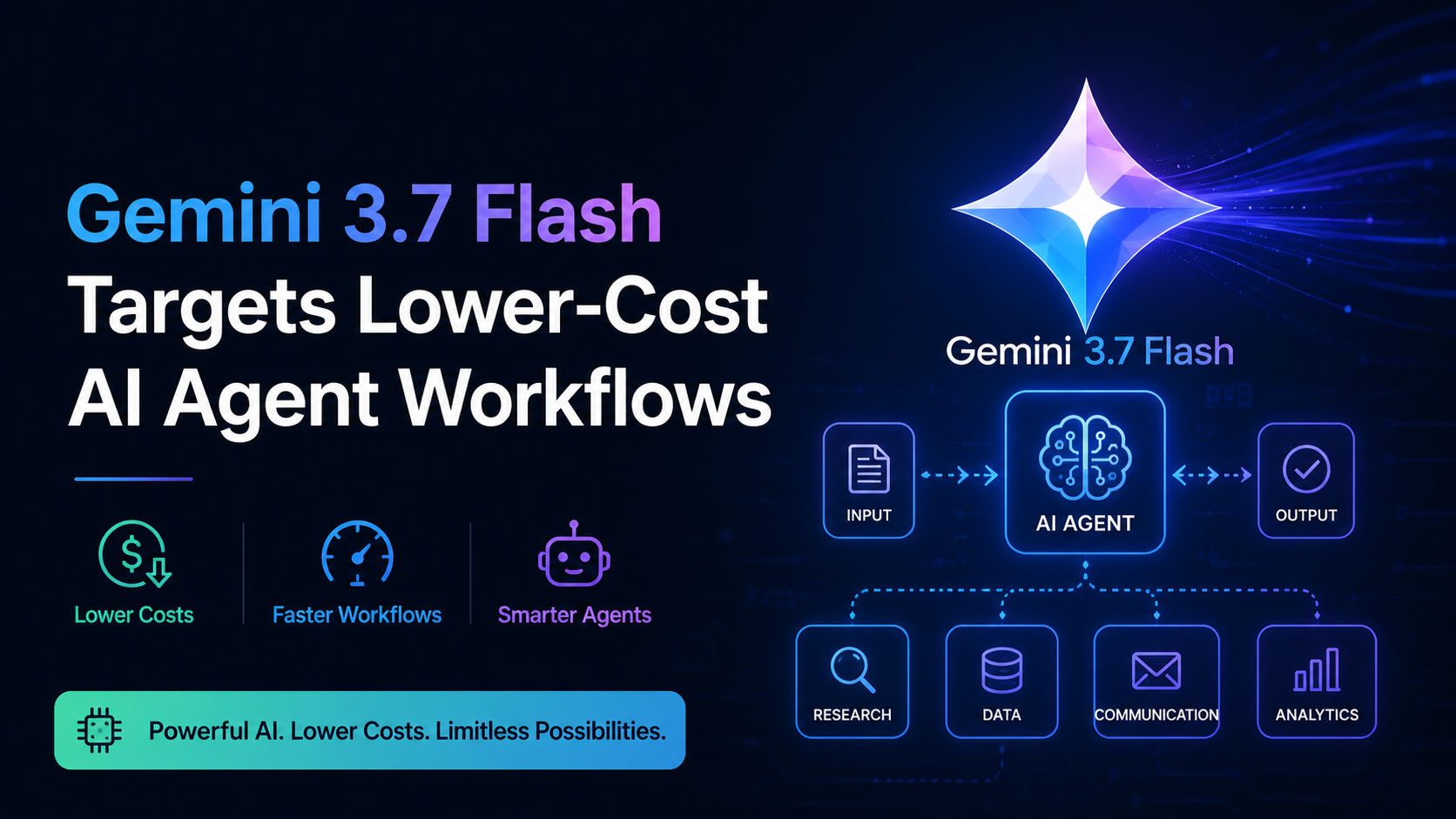
Quick answer: Gemini 3.7 Flash is Google's latest Flash-family AI model, released on August 13, 2026, with a focus on coding, software engineering and multi-step AI agent workflows. Google is pairing the new model's stronger planning and tool-use capabilities with lower introductory token pricing, according to The Indian Express and Yahoo Finance.
Key Facts
- Google released Gemini 3.7 Flash on Thursday, August 13, 2026, three weeks after the arrival of Gemini 3.6 Flash, according to The Indian Express.
- Google describes Gemini 3.7 Flash as its "most intelligent workhorse model yet" for coding and AI agents, according to The Indian Express.
- Gemini 3.7 Flash is designed for complex software engineering, multi-step planning and enterprise workflows while aiming to keep AI agent operating costs lower, The Indian Express reported.
- Yahoo Finance reported introductory pricing of $0.75 per million input tokens and $3.75 per million output tokens through the end of 2026, half the original cost of Gemini 3.6 Flash.
- According to MaxRave, Google reported benchmark gains including an increase from 34.4% to 43.6% on FrontierCode 1.1 Main and from 49.0% to 65.3% on DeepSWE v1.1.
Gemini 3.7 Flash Is Built Around Multi-Step Work
Google's Gemini 3.7 Flash launch is aimed at work that requires an AI system to do more than generate a single answer or code snippet. According to The Indian Express, the model is designed to better understand instructions, plan multiple steps, use tools and adapt when problems appear during a workflow.
That focus puts software engineering and agent-based automation at the center of the release. Google says Gemini 3.7 Flash is intended for coding, software engineering, web development and enterprise workflows where an AI agent may need to work through a sequence of tasks with less manual intervention.
Yahoo Finance similarly described the model as targeting businesses building systems that can plan tasks, use software tools and complete multi-step workflows with less human oversight. The outlet reported that Google highlighted improvements in debugging, issue resolution and production-ready code generation.
For developers, the practical distinction is the type of work being handed to the model. A system that can follow a longer chain of instructions, call tools and respond to problems can be used differently from a model primarily asked to answer a question or generate a standalone block of code. Gemini 3.7 Flash is being positioned for those longer-running workflows.
Why Gemini 3.7 Flash Pricing Is Part of the Story
The pricing attached to Gemini 3.7 Flash is as notable as the model update itself. Yahoo Finance reported that Google priced the model at $0.75 per million input tokens and $3.75 per million output tokens through the end of 2026.
According to Yahoo Finance, those introductory prices are half the original cost of Gemini 3.6 Flash. MaxRave also described the launch price as half the original Gemini 3.6 Flash cost per million tokens.
That matters specifically for AI agents because multi-step tasks can require repeated model calls. A workflow may involve planning, generating code, checking results, using a tool and responding to an error. Lower per-token costs can change the economics of running those repeated interactions, particularly when businesses are testing automated workflows at larger volumes.
Google's rapid release cycle also adds context. Gemini 3.7 Flash arrived only three weeks after Gemini 3.6 Flash, according to The Indian Express and Yahoo Finance. The pace suggests that Google is iterating quickly on the Flash models it expects developers to use for coding and automated tasks.
Coding Performance Is a Central Claim
Google's strongest claims around Gemini 3.7 Flash are tied to software development. The Indian Express reported that the model leans heavily toward coding, software engineering, web development and agentic workflows rather than being presented mainly as a general-purpose conversational model.
MaxRave reported several benchmark figures published by Google. On FrontierCode 1.1 Main, the reported score increased from 34.4% for Gemini 3.6 Flash to 43.6% for Gemini 3.7 Flash. On DeepSWE v1.1, the reported score rose from 49.0% to 65.3%. MaxRave also reported an increase from 1538 to 1588 Elo on WebDev Arena.
Google also highlighted stronger debugging and issue resolution, higher first-pass code accuracy and improved web development output, according to MaxRave. Those claims should be read as Google's published performance comparisons, but they make clear which workloads the company is prioritizing with Gemini 3.7 Flash.
The model is also aimed at document-heavy work in fields including finance, law and biosciences, according to MaxRave. That broadens the target beyond software development while keeping the common requirement intact: tasks that involve reasoning through a larger body of information and carrying out multiple steps.
What Gemini 3.7 Flash Means for AI Agent Builders
For teams building AI agents, Gemini 3.7 Flash combines three elements described across the research brief: multi-step planning, tool use and lower introductory pricing. The model is intended to reduce manual intervention when developers run workflows that encounter problems or need to adapt, according to The Indian Express.
That does not mean Gemini 3.7 Flash can independently solve every software engineering or enterprise task. The available reporting focuses on Google's improvements in instruction following, planning, coding and tool use rather than claiming full autonomy for complex business operations.
The more immediate use case is likely to be developers and businesses testing agents that handle defined sequences of work. Gemini 3.7 Flash is being presented as a model for systems that need to reason across steps rather than simply produce a single response and stop.
Yahoo Finance reported that Gemini 3.7 Flash was rolling out immediately to Gemini Spark. Beyond that rollout detail, the research brief does not provide a complete list of availability, deployment or product integration options, so those details should not be inferred from the launch announcement alone.
FAQ
What is Gemini 3.7 Flash?
Gemini 3.7 Flash is a Google AI model released on August 13, 2026. It is designed for coding, software engineering, web development and multi-step AI agent workflows.
How much does Gemini 3.7 Flash cost?
Yahoo Finance reported introductory pricing of $0.75 per million input tokens and $3.75 per million output tokens through the end of 2026. The outlet said this was half the original cost of Gemini 3.6 Flash.
How is Gemini 3.7 Flash different from Gemini 3.6 Flash?
Google reported improvements in coding, planning, debugging, issue resolution and agent-style workflows. MaxRave also reported higher Google-published scores on FrontierCode 1.1 Main and DeepSWE v1.1.
Is Gemini 3.7 Flash designed for AI agents?
Yes. Google positioned Gemini 3.7 Flash for AI agents that need to understand instructions, plan multiple steps, use tools and adapt when problems occur.
When was Gemini 3.7 Flash released?
Google released Gemini 3.7 Flash on August 13, 2026, according to The Indian Express. The launch came three weeks after Gemini 3.6 Flash.
Author