
Google Backstory Helps Fact-Checkers Investigate AI Fakes
AI KAPTAN
August 20, 2026
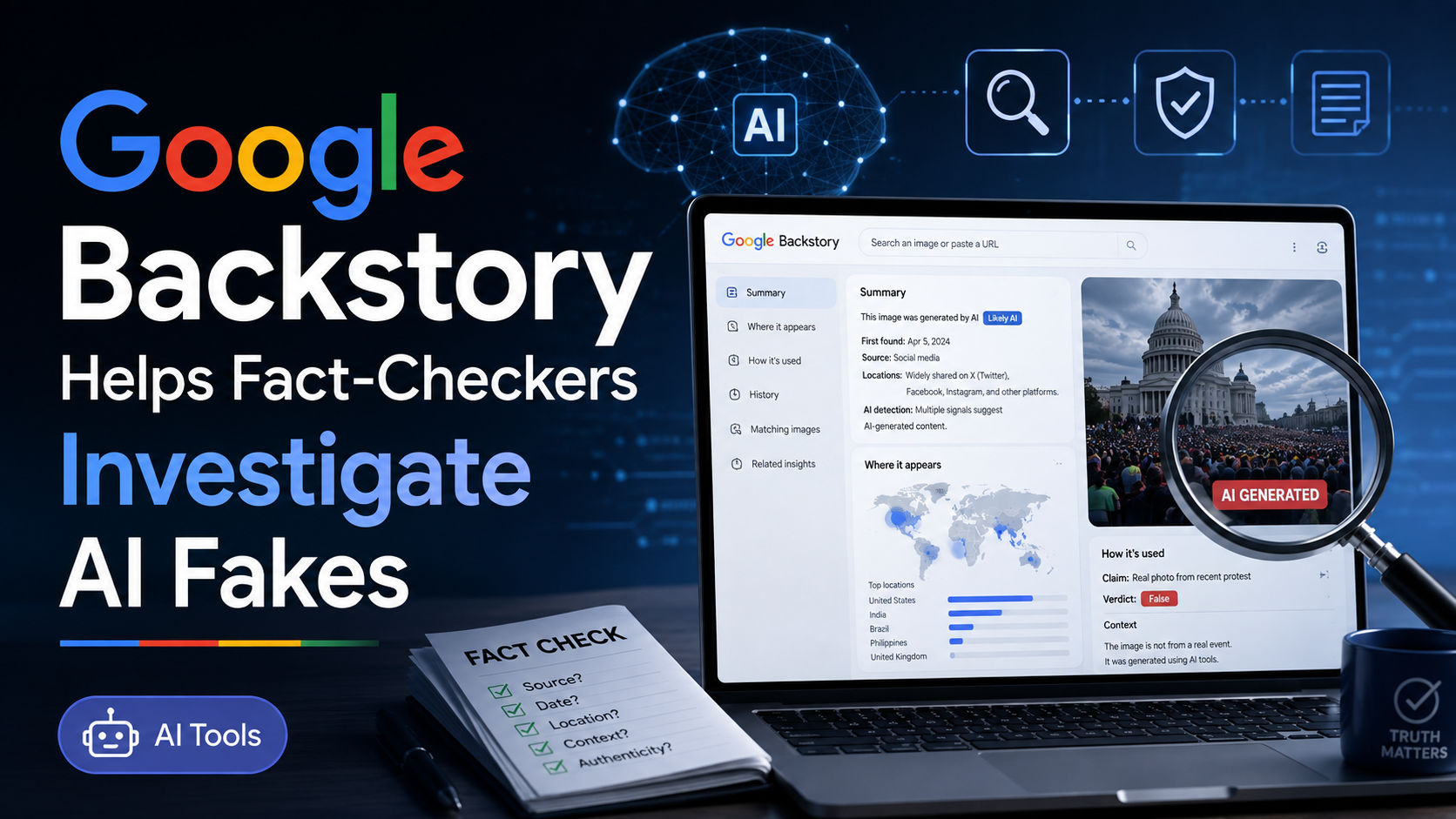
Quick answer: Google Backstory is an experimental tool from Google DeepMind designed to help fact-checkers investigate suspicious images. According to Nieman Lab, Google Backstory can examine whether an image may be AI-generated or manipulated, search for where it has appeared online, and produce a cited report explaining its findings and the steps taken.
Key Facts
- In August 2026, Nieman Lab reported that Google Backstory was being used experimentally by the fact-checking team at India Today, one of India's largest news organizations.
- India Today's fact-checking team has six members and handles false or misleading images circulating on social media, including AI-generated images, out-of-context footage, and deepfakes.
- Google Backstory is built on Google's Gemini family of large language models and uses AI agents to decide which authentication tools to use and in what order.
- After a user uploads an image and enters a basic question, Google Backstory can check whether the image may be AI-generated, whether it shows signs of manipulation, and where else the image has appeared online.
- Google Backstory produces an AI-generated report with citations and a log of the investigative steps taken.
What Google Backstory Actually Does
The central idea behind Google Backstory is to turn an image investigation into a guided workflow rather than requiring a fact-checker to manually choose and sequence every verification step.
According to Nieman Lab, a user begins by uploading an image and entering a basic question. Google Backstory then runs checks aimed at answering several practical questions: whether the image is AI-generated, whether it appears to have been manipulated, and where the image has appeared during its history on the internet.
The final result is more than a simple label. Google Backstory generates a report summarizing what the investigation found, includes citations, and records the steps taken during the process. That step log matters because an investigation can be reviewed as a sequence of actions rather than treated only as an unexplained AI verdict.
For fact-checking teams dealing with a constant stream of suspicious media, that structure addresses a specific problem: deciding what to investigate first and which verification methods to apply.
How Google Backstory Uses Gemini and AI Agents
Nieman Lab reports that Google Backstory is built on Google's Gemini family of large language models. Google Backstory also uses AI agents to determine which authentication tools should be used and in what sequence.
That makes the agent component part of the investigative process itself. Instead of describing AI agents in abstract terms, Google Backstory applies them to a defined task: selecting and ordering checks for a submitted image.
The research brief does not specify every authentication tool available to Google Backstory or explain the technical criteria used to select one check over another. Those details should not be inferred. What Nieman Lab does establish is that Google Backstory combines Gemini-based language models, AI agents, authentication checks, web-history investigation, and a generated report with citations.
Why India Today's Fact-Checking Team Is a Relevant Test Case
Nieman Lab describes India Today's six-person fact-checking team as dealing daily with false and misleading images circulating across social media. The examples cited by Nieman Lab include an AI-generated archival photograph of a politician, footage of deadly flooding removed from its original context, and a deepfake involving India's richest man.
Those examples show why image verification can involve several different questions. A piece of media may be synthetic. A real image or video may have been altered. Authentic footage may also be misleading because its date, location, or original context has changed as it moves across the internet.
Google Backstory is designed to investigate these different possibilities through one workflow. A fact-checker can ask a question about an uploaded image, while Google Backstory coordinates checks and returns a documented summary of what it found.
What Makes Google Backstory Different From a Simple AI Detector
Calling Google Backstory an AI-image detector would leave out much of the workflow described by Nieman Lab.
Google Backstory is intended to investigate multiple dimensions of an image. The tool can examine whether an image may be AI-generated, look for signs of manipulation, and investigate where the image has appeared online. Google Backstory then turns those findings into a cited report and provides a record of the steps used during the investigation.
That distinction matters for fact-checking because the question is often broader than whether a file was generated by AI. A misleading image can be authentic but old, authentic but altered, or synthetic and presented as genuine.
The brief also does not claim that Google Backstory can guarantee the truthfulness of every image or replace human fact-checkers. The documented workflow described by Nieman Lab places the tool inside an investigative process used by a professional fact-checking team.
Google Backstory Points to a More Documented Agent Workflow
Google Backstory offers a concrete example of AI agents being used to coordinate a bounded research task. The user supplies an image and a question. Google Backstory determines which authentication checks to perform, orders those checks, and produces a report describing the results.
The cited output and step log are particularly relevant to that design. When an AI system contributes to an investigation, the resulting workflow is more useful when readers can see what evidence was surfaced and what actions were taken.
According to Nieman Lab, Google Backstory is still experimental. The story should therefore be read as an account of an early deployment rather than evidence that Google Backstory has become a universal fact-checking system. The available details point to a narrower and more specific use: helping fact-checkers investigate suspicious images through a combination of Gemini models, AI agents, authentication tools, and documented results.
FAQ
What is Google Backstory?
Google Backstory is an experimental Google DeepMind tool that helps fact-checkers investigate suspicious images. According to Nieman Lab, it can examine possible AI generation or manipulation and investigate where an image has appeared online.
How does Google Backstory use AI agents?
Google Backstory uses AI agents to decide which authentication tools to use and in what order. The agents are part of the workflow that investigates an uploaded image and the user's question.
Is Google Backstory powered by Gemini?
Yes. Nieman Lab reported that Google Backstory is built on Google's Gemini family of large language models.
What information does Google Backstory provide after an investigation?
Google Backstory generates an AI-written report summarizing its findings, includes citations, and provides a log of the steps taken during the investigation.
Who is using Google Backstory?
Nieman Lab reported that India Today's six-person fact-checking team was using Google Backstory experimentally to help investigate false and misleading images circulating online.
Author