
India’s AI Tools Boom: 50 Products Built for India
AI KAPTAN
August 15, 2026
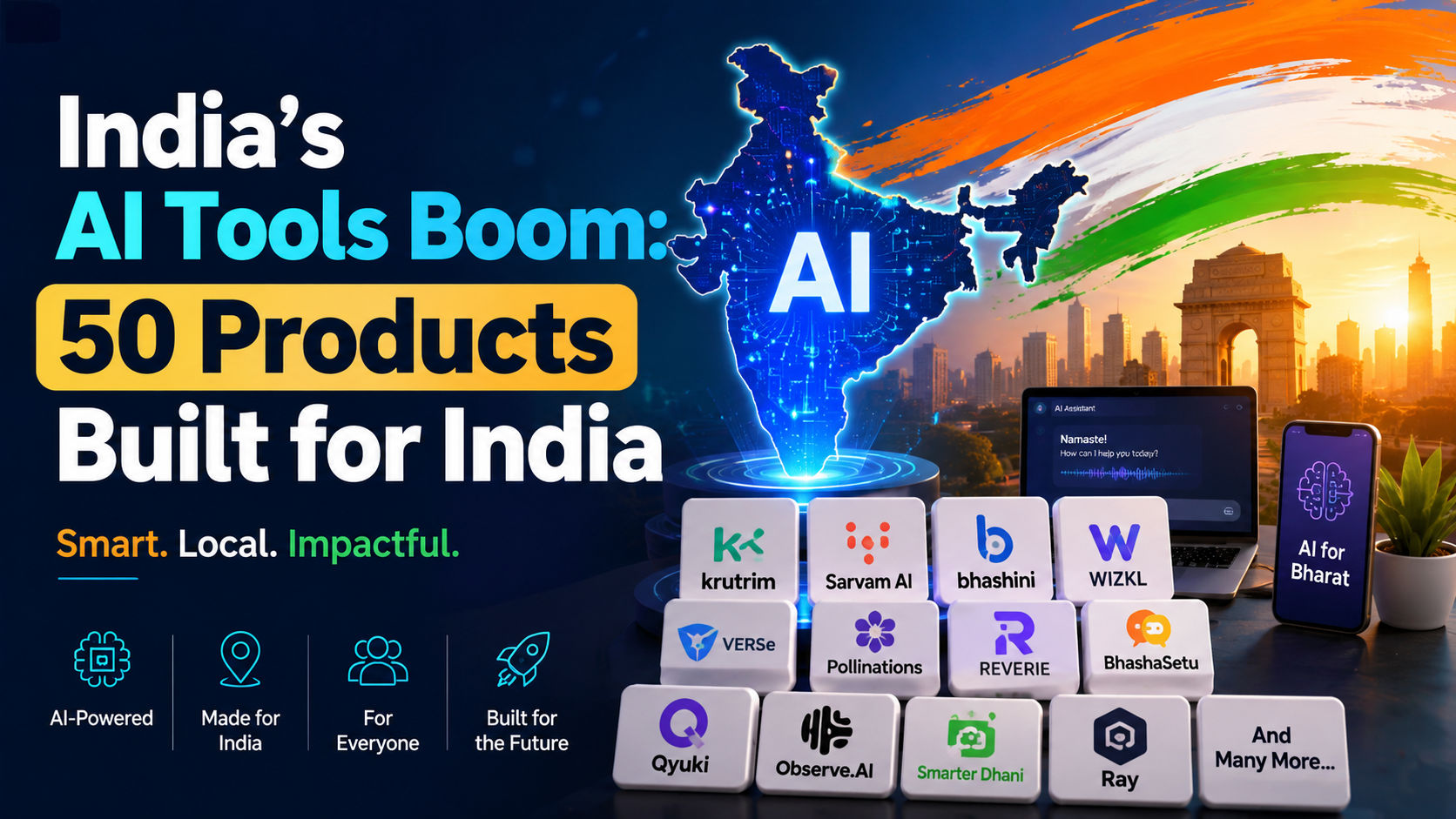
Quick answer: AI tools in India are expanding beyond applications built primarily on foreign models. A 2026 editorial directory from Parikshit Khanna identifies 50 notable Indian-created AI products across foundational models, Indic-language technology, enterprise agents, document automation, healthcare, education, identity, agriculture and video analytics.
Key Facts
- Parikshit Khanna’s 2026 directory compares 50 notable AI products founded or substantially developed in India, or led by an Indian public or academic institution.
- The directory covers foundational models, Indic-language speech and translation, enterprise agents, document automation, medical diagnostics, education platforms, identity verification, agricultural intelligence and video analytics.
- Parikshit Khanna says products were assessed using India-specific value, product maturity, technical importance, public deployment evidence and practical usefulness.
- Mastra’s 2026 business AI guide groups AI software by use case and argues that teams need to distinguish useful products from AI features that function more like demos.
- Google says new AI and agentic experiences across Google Ads and Google Analytics can summarize data, create visual reports from text prompts and benchmark performance against similar businesses.
AI Tools in India Move Beyond Foreign-Model Dependence
The strongest development in the current research is the breadth of AI tools in India being built for local requirements. Parikshit Khanna’s 2026 directory describes an Indian AI market that now includes work across the technology stack rather than only services built around models developed elsewhere.
The directory includes foundational models as well as products focused on Indic-language speech and translation. That distinction matters because language support can be a product capability in its own right rather than simply another interface feature.
The same directory also identifies Indian-created products for enterprise agents, document automation, medical diagnostics, education, identity verification, agricultural intelligence and video analytics. The range suggests that Indian AI development is being applied to specific operational problems across multiple sectors.
Parikshit Khanna defines “Indian-created” carefully. A product qualifies if it was founded or substantially developed in India, or if an Indian public or academic institution led its development. The designation does not mean that every product remains Indian-owned, is hosted exclusively in India or is sold only within India.
That qualification is important when comparing products. The origin of a product and its current ownership, infrastructure or customer base can be different things.
Why a 50-Product Directory Matters More Than a Simple Ranking
Parikshit Khanna does not present the 50 products as a universal ranking of the best AI tools. The directory instead emphasizes factors that can change the right choice for a particular organization: language coverage, accuracy on a company’s own data, security, deployment model, integrations, support and total cost.
That approach is more useful for buyers than treating AI software as a single category. A medical diagnostic product and an enterprise document automation system may both use AI, but their requirements, risks and evaluation criteria are different.
The directory also prioritizes product maturity and public deployment evidence. Those criteria help separate products that have demonstrated practical use from concepts that may have received attention without comparable deployment evidence.
Pricing is another consideration. Parikshit Khanna notes that prices were checked on public pages where available, while “Custom” indicates that a vendor requires a quote and “N/D” means pricing was not publicly disclosed or was not found in the research.
Business AI Is Becoming a Use-Case Decision
The broader AI-tools research points in the same direction. Mastra’s 2026 guide organizes business AI products by the job a team needs to accomplish, covering categories such as chatbots, analytics and agent frameworks.
Mastra describes a common problem for businesses: software vendors increasingly ship AI features, making it harder to distinguish products that save meaningful time from features that are closer to demonstrations. The guide therefore focuses on specific capabilities, trade-offs and use cases rather than treating every AI feature as equally useful.
This use-case approach also appears in OneSignal’s 2026 analysis of AI marketing tools. OneSignal argues that mobile marketing teams often need several specialized tools rather than selecting a single product that claims to cover every marketing task.
For creative production, OneSignal highlights Canva Magic Studio for producing first drafts of push notification images, in-app message visuals, App Store screenshots and feature-announcement social posts. The research describes text-to-image, text-to-video and AI copywriting capabilities as useful for the recurring volume of smaller campaign assets required by lifecycle marketing teams.
The result is a fragmented but practical buying model: organizations can select AI according to the specific workflow they need to improve.
Google Pushes AI Into Existing Marketing Workflows
Google’s latest marketing updates provide another example of this shift from standalone AI applications toward AI inside existing business software. According to Google, new AI and agentic experiences are being added across Google Ads and Google Analytics.
Google says users can access AI-powered summaries on homepages, create visual reports using simple text prompts and benchmark performance against similar businesses. Google also describes Ask Advisor as an in-product AI agent across its marketing platform.
The significance for businesses is practical. Instead of requiring a separate AI application for every analytical task, existing marketing platforms are adding AI capabilities directly where campaign and measurement data already exists.
That development reinforces a broader pattern visible across the research brief: the value of an AI tool increasingly depends on the workflow, data and context surrounding the model.
What Buyers Should Look for in Indian AI Products
For organizations evaluating AI tools in India, the 2026 research supports a criteria-based approach rather than a popularity-based one.
Language coverage matters when products must handle Indic languages or multilingual workflows. Accuracy on proprietary data matters when the tool operates on business documents, records or internal information. Security and deployment become important when sensitive information is involved.
Integrations also determine whether an AI product fits an existing workflow. A capable system that cannot connect to the tools a team already uses may deliver less practical value than a narrower product with better integration.
Finally, buyers should examine support and total cost. The Parikshit Khanna directory explicitly includes these factors in its guidance for selecting among Indian-created AI products.
The most useful takeaway from the 2026 research is not that one Indian AI product has won the market. The stronger finding is that there are now enough different products and use cases to make selection a real evaluation exercise.
FAQ
How many Indian AI products are covered in the 2026 directory?
Parikshit Khanna’s 2026 directory compares 50 notable AI products founded or substantially developed in India, or led by an Indian public or academic institution.
What types of AI tools are being developed in India?
The directory covers foundational models, Indic-language speech and translation, enterprise agents, document automation, medical diagnostics, education, identity verification, agricultural intelligence and video analytics.
Does “Indian-created” mean a product is Indian-owned?
No. Parikshit Khanna says “Indian-created” does not mean every product is currently Indian-owned, hosted only in India or sold exclusively in India.
How should businesses evaluate AI tools?
The research points to language coverage, accuracy on the organization’s own data, security, deployment model, integrations, support and total cost as important selection criteria.
Are AI marketing tools replacing entire marketing software stacks?
OneSignal’s 2026 analysis argues that mobile marketing teams will often use multiple specialized AI tools because different products address different jobs.
What AI features has Google added to its marketing platforms?
Google says new AI and agentic experiences across Google Ads and Google Analytics can summarize data, create visual reports from text prompts and benchmark performance against similar businesses.
Author