Meta and Nvidia Reshape Open-Weight AI Development
AI KAPTAN
August 18, 2026
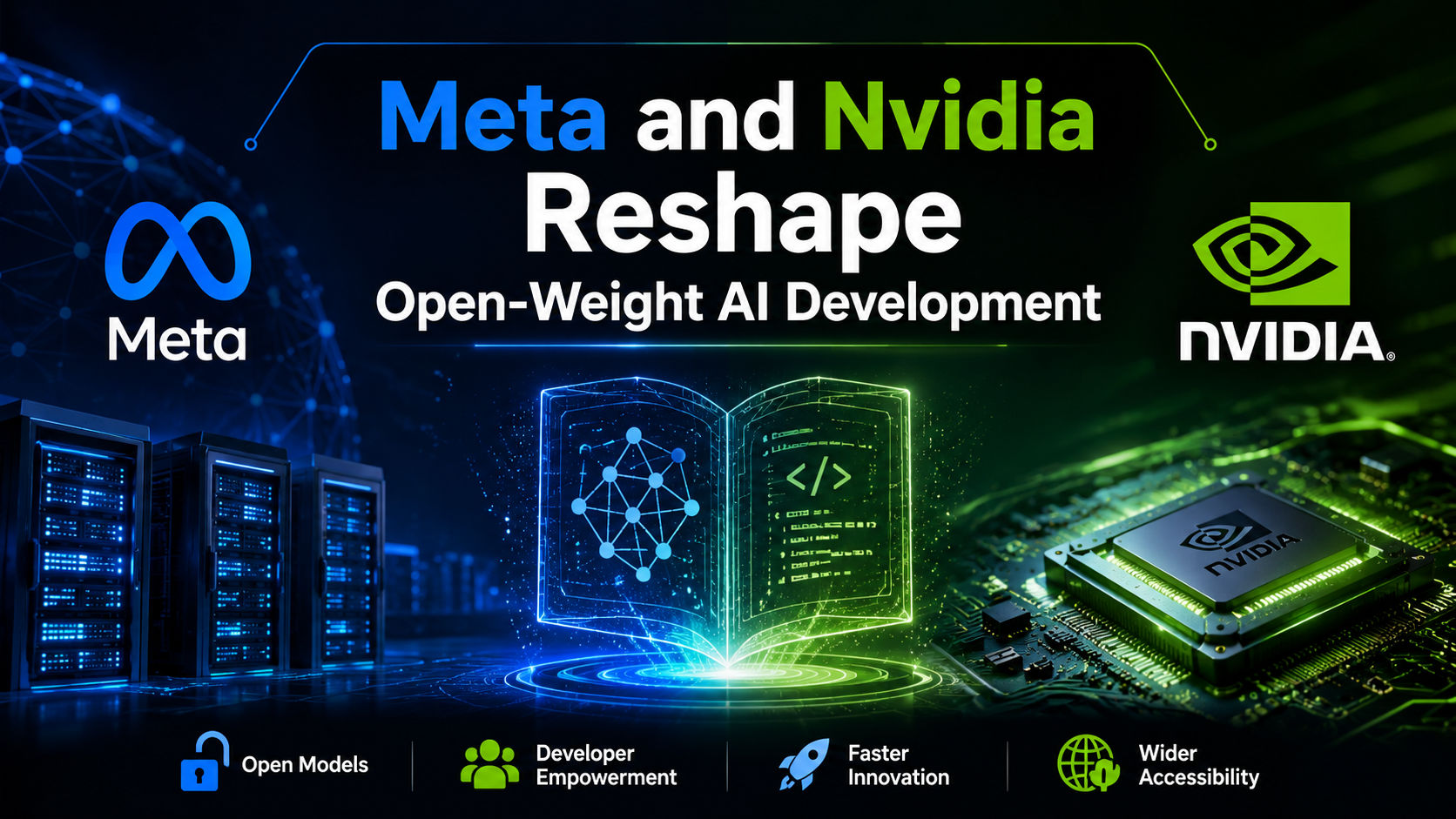
Quick answer: Meta and Nvidia are helping move open-weight AI toward a more practical development model, where developers can work with model weights and adapt AI systems to specific environments. The shift matters because open-weight models give organisations more control over deployment, customisation, and infrastructure choices than hosted-only systems.
Why open-weight AI is getting more attention
Open-weight AI refers to models whose trained weights are made available so developers can download, run, evaluate, and adapt the model within the limits of its licence. That creates a different development experience from relying entirely on an API operated by a model provider.
Meta has been one of the most visible companies pursuing this approach through its Llama model family. Nvidia, meanwhile, sits on the infrastructure side of the ecosystem, supplying the GPUs and software stack used to train and run many modern AI models.
The combination matters because model availability and computing infrastructure are closely connected. A model can be publicly available while still being difficult to operate at useful scale if organisations lack suitable hardware and software support.
Meta and Nvidia's role in open-weight AI
Meta's contribution to open-weight AI has centred on making model weights available to developers and organisations. That gives engineering teams the ability to run models outside a single hosted interface and experiment with deployment configurations that would be difficult to achieve with a closed API alone.
Nvidia approaches the same ecosystem from a different position. Nvidia's GPUs provide the computing capacity required for model training and inference, while Nvidia's broader software ecosystem helps developers build applications around accelerated AI workloads.
Together, these positions illustrate why open-weight AI is increasingly treated as an infrastructure question rather than simply a model-release strategy. Developers need the model, but they also need practical ways to run it.
What developers gain from open-weight AI
One of the clearest benefits of open-weight AI is deployment control. An organisation can choose where a model runs instead of automatically sending every inference request to an external API.
That can be useful for teams building internal applications, specialised assistants, research systems, or products where deployment architecture is part of the engineering requirements. Developers can also test models against their own workloads instead of relying exclusively on public benchmarks.
Another advantage is customisation. Open-weight models can be integrated into application-specific pipelines and, where the model and licence permit it, adapted for particular requirements.
This changes the role of the application developer. Instead of treating a model as a remote service with a fixed interface, developers can treat the model as one component of a larger software system.
The trade-off: access does not remove infrastructure costs
Open-weight AI does not mean that running AI becomes free. Model weights still require computing resources, storage, memory, engineering work, and operational maintenance.
This is where Nvidia's position becomes relevant. Running larger models can require substantial GPU capacity, and inference performance depends on factors such as hardware, model size, quantisation, batching, and application architecture.
For smaller teams, hosted AI services can still be simpler because the provider manages the underlying infrastructure. Open-weight deployment becomes more attractive when control, customisation, data handling, or workload economics justify the additional operational responsibility.
Why this changes how companies evaluate AI models
The traditional question has often been which model produces the best answer. Open-weight AI introduces several additional questions: Can the model be deployed where the organisation needs it? Can engineers inspect and evaluate its behaviour? Can the model fit the available hardware? What level of customisation is possible under its licence?
Those questions make model selection more closely resemble a software infrastructure decision.
For engineering teams, the practical evaluation process can therefore include both model quality and deployment requirements. A model that performs well in a benchmark may not be the best choice if its operational requirements do not fit the product architecture.
Where Meta and Nvidia fit in the next stage
Meta's open-weight approach gives developers access to models they can incorporate into their own systems, while Nvidia provides much of the computing infrastructure used across the AI development ecosystem.
That combination points toward a more distributed AI development model. Instead of every application depending on a central hosted model endpoint, some teams can build systems where models, inference infrastructure, application code, and data are controlled as separate components.
The result is a more technical AI stack. Developers increasingly need to understand not only prompting and application design, but also inference hardware, model formats, optimisation, deployment, and operational costs.
For companies deciding between hosted and open-weight systems, the choice is less about ideology and more about requirements. Hosted models reduce infrastructure work. Open-weight AI can provide more control. The right option depends on what the application needs from the model and the infrastructure around it.
FAQ
What is open-weight AI?
Open-weight AI refers to AI models whose trained weights are made available for developers to use, evaluate, and potentially adapt according to the applicable licence.
Why is Meta associated with open-weight AI?
Meta has made model weights available through its Llama model family, allowing developers and organisations to work with models outside a purely hosted API environment.
What role does Nvidia play in AI development?
Nvidia provides GPUs and software infrastructure used for training and running AI models, making Nvidia an important part of the computing layer behind modern AI applications.
Is open-weight AI free to operate?
No. Access to model weights does not remove the cost of computing, storage, engineering, deployment, and ongoing maintenance required to run AI systems.
Why would a company choose an open-weight model?
Companies may choose an open-weight model when deployment control, customisation, infrastructure flexibility, or data-handling requirements make running the model themselves attractive.
Are hosted AI models still useful?
Yes. Hosted models can reduce infrastructure and operational work because the provider manages the underlying serving environment, making them practical for many applications.
Author