
Morphic Brings AI UGC Ads Into One Video Canvas
AI KAPTAN
August 19, 2026
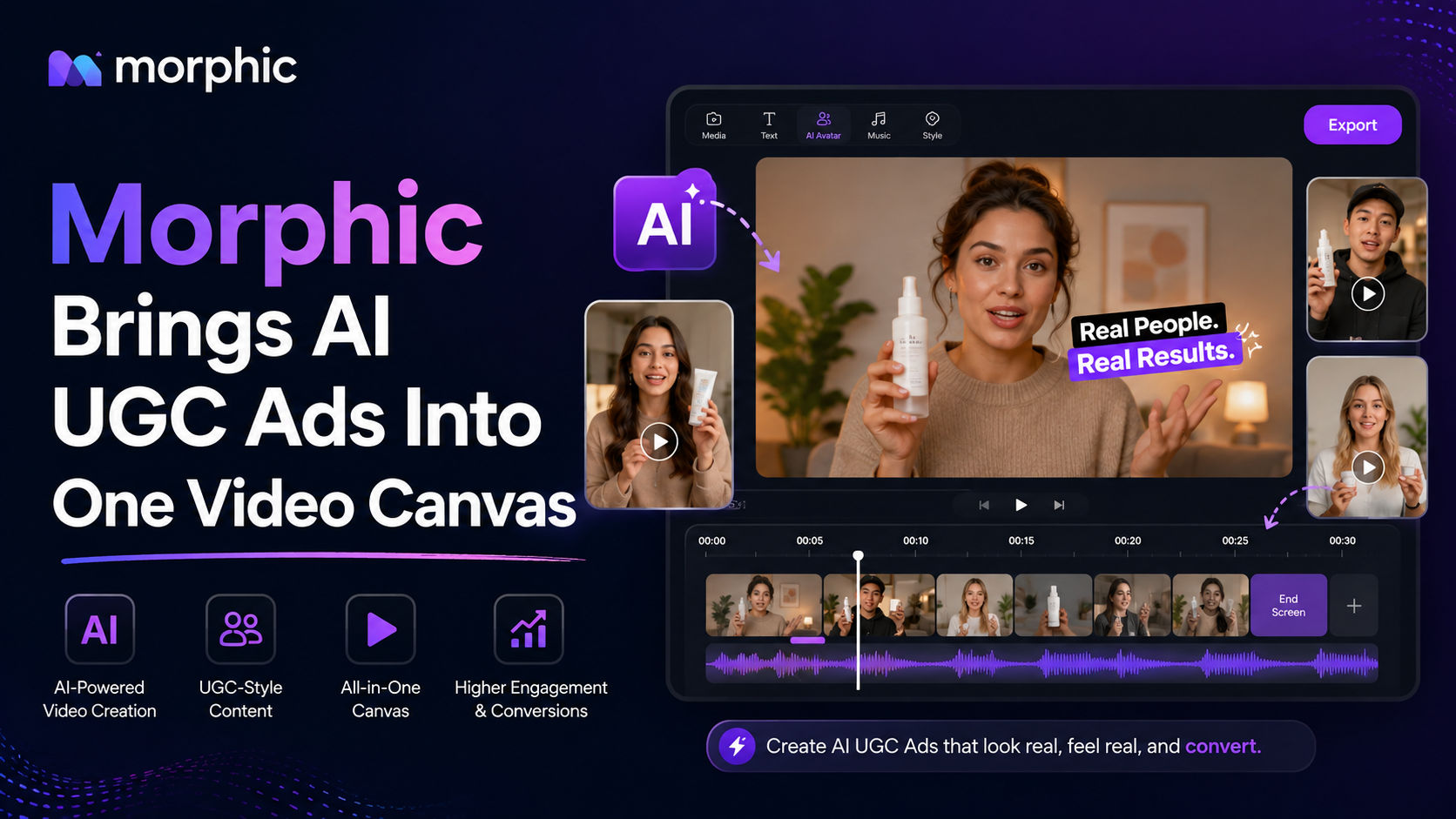
Quick answer: Morphic AI UGC is designed to bring creator-style ad production into a single Canvas. According to Morphic, users can combine several flagship video models, add voiceover and captions, and edit the finished ad in the same workspace.
Key Facts
- Morphic describes its platform as a way to build UGC-style ads across several flagship video models in one Canvas.
- Morphic's 2026 guide on AI UGC ad tools says the platform can work across models including Veo, Kling and Seedance.
- Morphic combines video generation, voiceover, captions and timeline editing in the same Canvas.
- Morphic says its workflow can be used to create UGC-style ads from a script and product.
- Morphic's guide describes different AI UGC tools as specializing in areas such as AI actor range, realism, hook testing, script-to-video speed and production control.
What Morphic AI UGC Does
Morphic AI UGC focuses on a practical problem in AI advertising: the creative process often involves several separate steps. A marketer may need to turn a script into video, choose a suitable visual style, generate a voiceover, add captions and then edit the final asset before it can be used in a campaign.
According to Morphic's guide, Morphic brings those steps together inside one Canvas. Users can build a UGC-style advertisement across multiple video models and then add voiceover, captions and a cut on the timeline without moving the project to another editing environment.
That positioning makes Morphic different from an AI tool that focuses only on avatar generation or only on text-to-video generation. The product is presented as a place where generation and post-production can happen in the same workflow.
Morphic AI UGC and Multiple Video Models
One of the clearest details in Morphic's description is its support for several flagship video models. Morphic specifically names Veo, Kling and Seedance among the models available for building UGC-style ads across its Canvas.
For advertisers, the practical value is the ability to approach the same creative idea through different generation systems rather than treating a single model as the entire production workflow. The research brief does not provide comparative performance figures for Veo, Kling or Seedance inside Morphic, so claims about which model produces the most realistic or effective advertisement would go beyond the available evidence.
The important point is the workflow: Morphic places multiple generation options inside the same creative environment and then provides editing capabilities around the generated material.
From Script to Finished UGC Ad
Morphic's description starts with a familiar advertising input: a script and a product. From there, the platform is positioned as a way to create creator-style video content rather than a conventional polished commercial.
The workflow includes more than generating a talking character. Morphic says users can add voiceover and captions and make a cut on the timeline. That means the final stage of preparing an ad is part of the same environment as the initial generation step.
For teams producing multiple creative variations, this matters because the work does not end when the video model generates a clip. A usable ad still needs structure, spoken audio, captions and editing. Morphic's approach puts those tasks together rather than treating them as separate production stages.
Where Morphic Fits Among AI UGC Tools
Morphic's own 2026 comparison of AI UGC ad tools makes an important distinction: different products lead in different parts of the workflow. Some focus on large libraries of AI actors. Others focus on realism, hook testing, script-to-video speed or full production control.
Morphic is positioned around full creative production inside one Canvas. The platform can generate UGC-style clips using multiple video models and then handle voiceover, captions and editing in the same workspace.
That distinction is useful when evaluating an AI UGC platform. A large actor library may be the main requirement for one campaign, while another campaign may need more control over the complete advertisement. The research brief does not establish a universal winner, and Morphic's own comparison explicitly frames tool selection around the job a marketer needs to complete.
Why the Canvas Workflow Matters for Advertisers
The strongest case for Morphic is less about any individual generated clip and more about how the production process is assembled.
A UGC advertisement can involve several creative decisions: the script, the person or character presenting it, the video generation model, voiceover, captions and the final cut. Morphic combines those components in one Canvas, according to the company's own description.
That can make the platform relevant to marketers who want to move between generation and editing without rebuilding the project in separate tools. The available research does not provide campaign performance numbers for Morphic, so there is no basis in the brief for claiming that Morphic ads produce a specific return on ad spend, click-through rate or engagement increase.
Instead, the concrete advantage described by Morphic is workflow consolidation: several parts of AI UGC production are available in the same workspace.
What the Research Does Not Establish
The available research brief provides a clear description of Morphic's product workflow, but it does not provide pricing, customer numbers, performance benchmarks or independent testing results for Morphic.
That means buyers should separate product capabilities from advertising outcomes. Morphic provides tools for generating and editing UGC-style creative, but the brief does not establish how those assets perform against footage created by human creators or against other AI UGC platforms.
The same limitation applies to individual video models. Morphic names Veo, Kling and Seedance as supported models, but the brief does not provide a controlled comparison of their output quality, generation speed or cost inside Morphic.
For marketers evaluating Morphic, the clearest evidence available from the research is therefore the production workflow itself.
FAQ
What is Morphic AI UGC?
Morphic AI UGC refers to Morphic's workflow for creating UGC-style advertisements using multiple AI video models in one Canvas, with voiceover, captions and editing included in the same environment.
Which AI video models does Morphic mention?
Morphic specifically mentions Veo, Kling and Seedance among the flagship video models that can be used inside its Canvas for UGC-style creative.
Can Morphic add voiceovers and captions?
Yes. According to Morphic, users can add voiceover and captions to generated UGC-style clips and make the final cut on a timeline within the same Canvas.
Is Morphic only an AI avatar generator?
No. The research brief describes Morphic as a broader creative workflow that combines multiple video-generation models with voiceover, captions and editing.
Does the research prove that Morphic improves ROAS?
No. The provided research brief does not contain independent ROAS, click-through-rate or engagement benchmarks for Morphic, so those outcomes cannot be established from the available evidence.
Author