
Slack and Claude Explore How Human-Agent Teams Work
AI KAPTAN
August 20, 2026
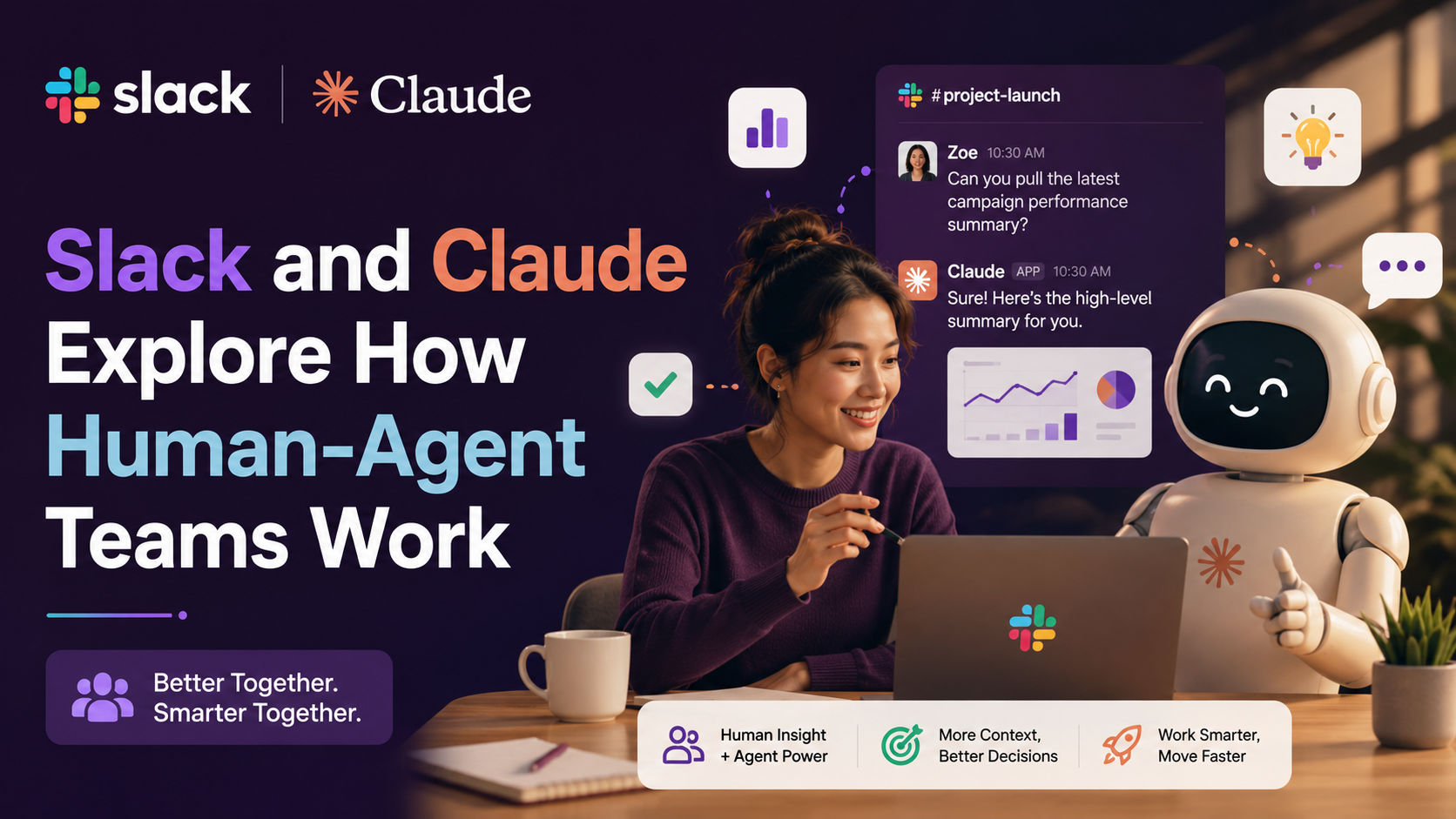
Quick answer: Slack's approach to human-agent teams centers on making workplace conversations, decisions, and work in progress available as context that AI agents can use. In a Claude by Anthropic interview with Slack Chief Product Officer Jaime DeLanghe, Slack describes open, searchable conversations as a foundation for turning organizational knowledge into useful agent context.
Key Facts
- Claude by Anthropic published its conversation with Slack Chief Product Officer Jaime DeLanghe as the second post in its series on building human-agent teams.
- Jaime DeLanghe joined Slack in 2017 to work on search and machine learning, with a mission focused on turning workplace conversation into institutional knowledge.
- Slack's approach emphasizes keeping conversations, decisions, and work in progress in channels that people across the company can read and search.
- According to Claude by Anthropic, Jaime DeLanghe argues that conversations surrounding work provide the context AI agents need to be useful.
- The Claude by Anthropic article follows an earlier post in the series about lessons from building teams with multiplayer AI at Anthropic.
Why Slack's Conversation Model Matters for Human-Agent Teams
The discussion between Claude by Anthropic and Slack starts with a simple premise: workplace knowledge is often embedded in conversations rather than stored neatly in formal documents.
According to the Claude by Anthropic article, Jaime DeLanghe has pursued the idea of turning workplace conversation into institutional knowledge since joining Slack in 2017. Slack's model encourages work to happen in channels where conversations, decisions, and ongoing work can be read and searched by others inside the organization.
That same structure now has implications for AI agents. An agent asked to help with work needs more than an isolated prompt. The surrounding discussion can explain why a decision was made, what has already been tried, which questions remain open, and where work currently stands.
Claude by Anthropic frames this context as central to building effective human-agent teams. The useful unit is not simply a person asking an AI system for an answer. The agent also needs access to the conversation around the work it is being asked to support.
From Search and Machine Learning to Agent Context
Slack's earlier focus on search provides part of the background for this approach. Jaime DeLanghe originally joined Slack to work on search and machine learning, according to Claude by Anthropic.
Search and AI agents solve different problems, but both depend on finding relevant information inside a large volume of workplace activity. A searchable record can help a person recover an earlier decision. An AI agent working in the same environment may also need that record to understand a request in context.
The difference is that an agent may use the retrieved context as part of an active workflow. Instead of only locating a message, an agent can use the surrounding conversation while helping a person work through a task.
That makes the quality and availability of context a practical question. If important discussions happen across channels, the agent's usefulness depends on whether the relevant conversation is accessible and understandable within the work environment.
Slack's Case for Working in the Open
Claude by Anthropic describes Slack's philosophy as keeping conversations, decisions, and work in progress in channels that anyone in the company can read and search.
The goal is not presented simply as documenting completed work. Work in progress also carries context. A final document may record an outcome while leaving out the alternatives discussed, objections raised, or assumptions that shaped the decision.
For human-agent teams, that distinction matters. An agent receiving only a final artifact may understand what happened without understanding the reasoning and conversation around it. Access to the broader discussion can provide additional context for later work.
Jaime DeLanghe makes a similar argument about agents in her essay The Work is the Conversation, as described in the Claude by Anthropic interview. The conversation around work is presented as the context agents need to become useful participants in workplace workflows.
What This Means for Human-Agent Collaboration
The Claude by Anthropic series focuses on how organizations can build teams in which people and AI agents work together. Slack's contribution to that discussion is rooted in how knowledge is created and retained during everyday collaboration.
A workplace agent does not operate in a vacuum. Its usefulness depends partly on whether it can understand the task and the information surrounding that task. Slack's model treats conversations as part of the knowledge available for future work rather than as disposable chat history.
That creates a different way to think about organizational AI. The question is not only what an AI model can generate after receiving a prompt. It is also what context exists around the work and whether that context can support the interaction between people and agents.
Claude by Anthropic's interview with Jaime DeLanghe does not present a single product announcement or a list of technical specifications. Instead, it documents a specific working model: conversations, decisions, and ongoing work can form a shared source of context for people and AI agents operating in the same organization.
The Open Question: How Much Context Is Useful?
More available conversation does not automatically produce better results. The material in the Claude by Anthropic article points to the value of context, but it also highlights the challenge of making workplace information useful rather than simply abundant.
Human workers already face the problem of finding relevant information inside large volumes of messages and documents. AI agents working with workplace conversations face the same basic requirement: they need the right context for the task at hand.
Slack's long-standing emphasis on searchable workplace conversation gives its approach to human-agent teams a clear foundation. The model starts with the assumption that context is created during collaboration and that preserving the conversation around the work can make that context available later.
For organizations experimenting with AI agents, the Claude by Anthropic interview offers a practical framing. Before asking how autonomous an agent should become, there is another question worth answering: where will the agent get the context needed to understand the work alongside the people doing it?
FAQ
What are human-agent teams?
Human-agent teams are groups in which people and AI agents work together on shared tasks. In the Slack discussion published by Claude by Anthropic, useful collaboration depends heavily on giving agents relevant context around the work.
Why does Slack treat conversations as important context for AI agents?
According to Claude by Anthropic's interview with Jaime DeLanghe, conversations contain decisions and work in progress that can help explain the context around a task. Slack's approach is based on keeping that information readable and searchable inside channels.
Who is Jaime DeLanghe at Slack?
Jaime DeLanghe is Slack's Chief Product Officer. Claude by Anthropic says Jaime DeLanghe joined Slack in 2017 to work on search and machine learning.
What is the Claude by Anthropic human-agent teams series?
The article about Slack is the second post in Claude by Anthropic's series on building human-agent teams. The earlier post covered lessons from building teams with multiplayer AI at Anthropic.
What does Slack mean by turning conversation into institutional knowledge?
Slack's approach, as described by Claude by Anthropic, is to keep workplace conversations, decisions, and work in progress in channels that can be read and searched. This allows information created during collaboration to remain available as organizational context.
Does the Slack article announce a new AI product?
The research brief describes the Claude by Anthropic piece as a conversation about working practices and human-agent teams rather than a specific new Slack product launch. Its focus is how workplace conversation can provide useful context for AI agents.
Author